
SPRINGFIELD — Illinois lawmakers are weighing in on a pair of measures that aim to modernize state transportation laws and change how municipalities are held liable for road safety.
The legislative package includes a high-tech crackdown on extreme speeding and a shift in the legal status of bicyclists on Illinois roads. Advocates for safer streets gathered at the State Capitol last month as part of the annual Ride Illinois Bike and Trail Lobby Day to push for the changes as the spring session nears its conclusion.
Monitoring “super speeders”
One measure, known as the “Stop Super Speeders” bill, would establish a new protocol for repeat traffic offenders. Under the proposal, drivers caught going 26 miles per hour or more over the speed limit could avoid a mandatory license suspension by installing an electronic speed governor on their vehicles.
The technology, often referred to as Intelligent Speed Assistance, physically prevents a vehicle from exceeding a set speed limit.
State Representative Jennifer Sanalitro (R-Itasca) initially voted against the plan when it was before the House. During the lobby day event, Sanalitro spoke about her decision-making process regarding the use of such devices.
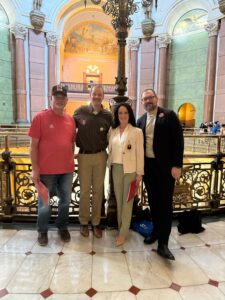
“If I voted no then I’m sorry I voted no. I don’t necessarily know what my reasoning was,” Sanalitro said. “I think I thought the FOP [Fraternal Order of Police] was against it. The only time I believe that you should have a device in your car is if you’re a drunk driver.”
While advocates were able to speak with Sanalitro, other legislators, including Representative Seth Lewis (R-Bartlett), were unavailable for scheduled meetings during the event.
The measure passed the Illinois House in April with a 77-24 vote and is currently under consideration in the Senate.
Liability and “intended” road users
A second bill currently in the Senate Transportation Committee seeks to clarify the legal standing of cyclists. The legislation would designate bicyclists as “intended” road users rather than “permitted” users.
Under current Illinois law, most municipalities cannot be held liable for injuries a cyclist sustains due to poor road maintenance—such as deep potholes or debris—unless the road was specifically marked as a designated bike route. Advocates argue this standard discourages towns from improving infrastructure.
“Illinois is the only state that has specifically stated that bicycles are permitted, but not intended,” said Dave Simmons, executive director of Ride Illinois. “Municipalities are sometimes reluctant to develop bike infrastructure, because once they do, they potentially open themselves up to liability.”
Supporters of the bill argue the change would force a shift in how local streets are planned and maintained. Savannah Curry, a coordinator for Ride Illinois, said the goal is to ensure cyclists are a primary consideration in engineering.
“Now it’s not just vehicles. Now it’s these bicyclists,” Curry said. “We need to consider them each time we need to make improvements or build new roads.”
Regional safety disparities
The push for these legislative changes comes as advocates point to significant disparities in traffic safety across the state. Rudy Faust, a member of Families for Safe Streets, noted that speed is a factor in nearly half of all traffic fatalities in Illinois.
Faust highlighted that these risks are not distributed equally within the seven-county Chicago metropolitan area.
“In the Chicago area… there’s also an extreme racial disparity to traffic deaths,” Faust said. “I believe it’s five times more likely for Black users of the road and three times more likely for Latino users of the road.”
If adopted, the measures would take effect as the state continues to update its long-range transportation plans. While the bills do not provide direct funding for new infrastructure, supporters say they establish the legal and technological framework necessary to reduce fatalities.
Champ,Feeds,News,Politics,Region: Champaign,Region: Central
via IPM Newsroom https://ipmnewsroom.org
May 12, 2026 at 03:40PM

