
By Nik Hunder
Nik Hunder is an environmental policy analyst, researcher, and public transit advocate based in Chicago.
Have you noticed people, often food delivery workers, operating bicycle-like devices without pedaling, traveling faster than 30 mph? Those aren’t bicycles by definition, even if they look like them. Illinois currently defines these devices, nicknamed “e-motos” by bike advocates, as electric motorcycles, but that designation is not all encompassing.
This had led to multiple suburban municipalities enacting their own electric bicycle laws. Often they are heavily restrictive. Elk Grove Village now requires any e-bike rider – even those operating Divvy-style e-bikes, which require pushing the pedals and have an electrical assist that tops off at 20 mph – to maintain a valid driver’s license. Fox Lake will impound your e-bike if it’s not insured. Glenview has banned them outright.
These inconsistent policies are difficult to navigate for riders who cross borders. The Illinois General Assembly recognizes this issue and is seeking to address it by enacting statewide micromobility regulations and taking away home rule (the right of municipalities to have differing regulations from the state level), preventing communities from passing more restrictive regulations than what the IGA is proposing.
SB3336 is the bill that would make this a reality. It’s a joint project between Ride Illinois and Secretary of State Alexi Giannoulias, with additional input from People for Bikes. It was announced in January 2026.
The bill’s primary goal
Micromobility is growing at a rapid pace, which has spurred an industry that is creating lots of different kinds of e-bikes and e-scooters. SB3336 defines many of these types of vehicles, including low/high-speed electric scooters and bikes; toy vehicles; unicycles; and electric skateboards. Again, electric motorcycles are already defined in the Illinois Vehicle Code.
No one is proposing substantial expansions of the electric motorcycle definition. Rather, any micromobility device that does not meet an existing or new definition is considered an electric motorcycle.
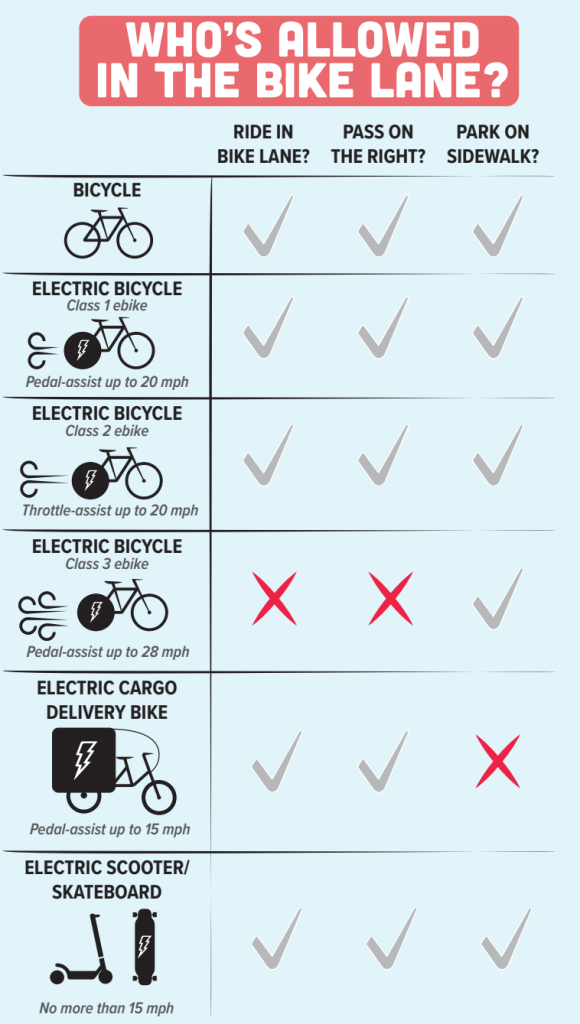
“One main objective of SB3336 is to clearly distinguish electric motor-driven cycles (aka e-motos) from legal classes of e-bikes,” Ride Illinois Executive Director Dave Simmons said via email. “Beyond 8,000 watts, a device is an electric motorcycle.” That term was proposed by the motorcyclists’ right organization ABATE Illinois. E-moto operators would be prohibited from riding on highways, sidewalks, multiuse paths, or any facility intended for non-electric bicycles and lower-speed electric micromobility devices. For example, as it stands, electric bicycles with an electrical assist up to 20 mph, and electric scooters/skateboards with an e-assist up to 15 mph, are permitted in Chicago bike lanes, but vehicles with a faster e-assist are not.
Registration requirements
Electric motorcycle users would be required to obtain a title and registration. However, a VIN number is needed to obtain a title. VIN numbers are not a common feature on any bicycle. U.S.-based manufactures instead put a proprietary serial number on the cycle, which the Illinois Secretary of State does not currently accept. Having any identifier is even less common when the manufacturer is based in another country.
Since e-motos generally don’t have VIN numbers, and therefore it’s difficult to get a title and registration for them, requiring those documents would potentially expose the operators to liability issues and confiscation of the devices by police.
“Details will need to be ironed out with guidance from the Secretary of State,” Simmons responded when asked about the VIN number issue. “We acknowledged early on that the Secretary of State will play a major role in the new guideline and process, which is why we decided to engage with them last summer to begin the discusion of sensible regulations for micromobility devices.”
The bill bans the sale of e-motos to consumers with marketing that promotes the vehicle as skirting Illinois licensing requirements because they don’t have a VIN number. marketing that advertises as skirting IL requirements. However, the legislation does not prohibit selling motor-driven cycles lack VIN numbers, as long as they’re not advertised as such.
Simmons acknowledged that this approach would not close all loopholes and would require follow-up from the state.
Clean-up bills are a common strategy of lawmakers that supplements major legislation packages through small tweaks to promote the originals bills’ intent based on new feedback. The Northern Illinois Transit Authority Act is expected to receive similar touchups.
Enforcement
The e-moto bill includes enforcement of the new title and registration rules through police confiscation and fines. However, if the manufacturer of the device misled the customer to believe the cycle would not require registration, the manufacturer would be held liable.
“We’re in agreement with law enforcement in that this shouldn’t be a large, additional burden on police departments,” Simmons said “There’s a fairly long period of time to educate the public (including parents) via awareness campaigns and lean on soft enforcement techniques to chip away at the (mostly) teen boys who have gravitated to e-motos.”
The new legislation sets the minimum age for riding an e-bike to 16, just like driving a car. “Hopefully it won’t take one or more tragedies for the majority of adults to take these devices away from their kids.” Simmons said.
The bill would also prohibit riding an e-moto while intoxicated, with the same rules that currently apply to motorists.
Last month, the Illinois Senate unanimously passed SB3336. It awaits a vote in the House. If passed and signed by Gov. JB Pritzker, the bill would take effect on New Year’s Day.

On November 12, SBC launched our 2026 fund drive to raise $50K through ad sales and donations. That will complete this year’s budget, at a time when it’s tough to find grant money. Big thanks to all the readers who have chipped in so far to help keep this site rolling to the end of 2026! Currently, we’re at $32,701 with $17,299 to go, ideally by the end of May.
If you value our livable streets reporting and advocacy, please consider making a tax-deductible gift here. If you can afford a contribution of $100 or more, think of that as a subscription. That will help keep the site paywall-free for people on tighter budgets, as well as decision-makers. Thanks for your support!
– John Greenfield, editor
Ino Saves New
via rk2’s favorite articles on Inoreader https://ift.tt/rfXa9Uw
May 8, 2026 at 10:47PM

