
Thursday, May 29, 2025 – Posted by Isabel Miller
* Subscribers were briefed on the Senate transit revenue plan this morning. The House’s transit bill fact sheet…
NORTHERN ILLINOIS TRANSIT AUTHORITY (NITA) TO REPLACE THE RTA
• The strengthened regional agency is tasked with coordinating service, planning, and funding across the region.
• The Service Boards remain independent agencies, primarily tasked with operating and managing the public transportation service for the region. This will include:
o Overseeing all existing employees under a collective bargaining agreement and hiring any new employees.
o Participating in planning and coordination of certain functions overseen by the Authority.
o Capital maintenance projects.NITA WILL BE A STRENGTHENED REGIONAL AGENCY COMPARED TO THE RTA
• Fares and Coordinated Fare Collection: NITA shall have the sole authority to set and coordinate fares; however, all fare revenue will go back to the Service Board that provided the service.
• Budget and Financial Plan: NITA is charged with developing an annual budget, in which the Service Boards shall review and provide input for the Authority’s consideration prior to final adoption.
• Capital planning & programming: NITA shall have the authority to develop the 5-year capital program, using a defined prioritization process; the Service Boards will submit projects for consideration in the program. NITA will manage large-scale, infrastructure expansion, and multiple-service board infrastructure projects, while Service Boards will be assigned infrastructure renewal, routine maintenance, vehicle overhaul projects, and others as deemed necessary by the Authority.
• Service Planning and Service Standards: using defined Service Standards to be developed in the coming years, NITA will develop a regionally coordinated service plan that describes all service to be provided in the coming year or years, with Service Boards submitting proposed service plans; NITA will ultimately evaluate service based on performance standards.
BOARD CHANGES
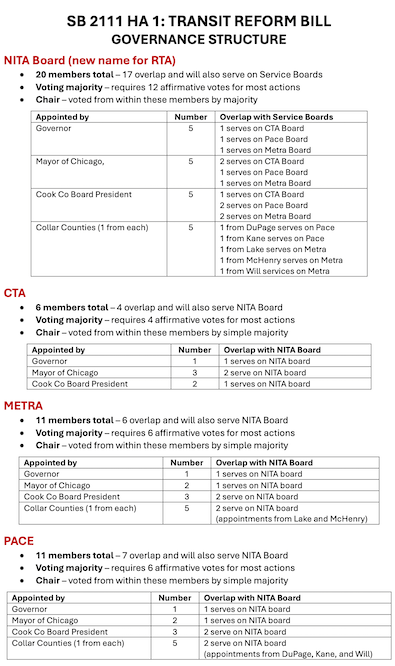
• New board structure: more than half of the boards of the Service Boards are made up of NITA board members, to guarantee improved coordination and a regional vision across all boards.
• Changes related to RTA board and all Service Board member requirements:
o All boards will have 5-year terms.
o New boards will be appointed and take affect February 1, 2026 – with existing board members eligible to be reappointed.• Board member qualifications: new language added that requires board members for NITA and all service boards to have relevant experience, including having backgrounds in urban and regional planning, management of large capital projects, labor and workforce development, business management, public administration, transportation, and community organizations.
• NITA Board training: Required to complete annual training on financial management and procurement laws, policies, and procedures.
ACCOUNTABILITY
• Require Performance Audits: the Auditor General shall conduct an independent performance audit of the Authority and Service Boards every 5 years.
• Create Chief internal Auditor: created within NITA to lead internal audits to proactively assess compliance with statutory mandates across the regional authority and service boards.
• Oversight of Service Board Executive Directors: Service board ED must be approved by the NITA board, must report to the NITA Board for annual performance reviews, and the NITA board has the authority to vote to remove a service board ED for just cause or failure to comply with plans implemented by the Authority.
• Farebox Recovery Ratio: reduced to 25% for first 3 years and if the Authority fails to reach this, funds will be withheld. Beginning January 1, 2029, the farebox recovery ratio reduces to 20% and becomes a performance measure; if the ratio falls below 20% for 2 consecutive years, the Authority must report to the General Assembly and consider strategies to achieve this ratio.
SAFETY
• NITA Law Enforcement Task Force: The Cook County Sheriff’s Office shall establish a multi-jurisdictional task force comprised of officers from the Cook County Sheriff’s Office, Chicago PD, Metra Police, IL State Police, and other local law enforcement departments. The Task Force shall be dedicated to crime mitigation and NITA public transportation systems.
• Sworn Officer Crime Prevention Program: taking into account recommendations from the Task Force, NITA shall vote to implement a sworn law enforcement crime prevention program and crime prevention plan within 1 year of the effective date of the bill.
• Office of Transit Safety and Experience: NITA shall establish a new safety office, which will coordinate with the Authority, law enforcement agencies, workers, and riders to implement safety strategies. The Director of the Office shall be a full-time Chief Transit Safety Officer, who must formerly have been a sworn law-enforcement officer.
• Coordinated Safety Response Council: crated under the Office of Transit Safety and Experience, this Council shall be made up of representatives from Service Boards, labor, law enforcement officers, social service providers, and others. The council shall be ongoing and charged with overseeing safety policies and programs.
• Bus Shields: shall be installed by January 1, 2028 and future procurements of new fixed-route buses shall consider security barriers and safety.
• Transit Ambassadors: transit ambassador program will be implemented to increase safety for passengers and personnel, provide passenger education and assistance, and aid in navigation
of the system.FUNDING DISTRIBUTION CHANGES
• Formula Changes: existing formulas will no longer be used and funding will be distributed under a new process, described below.
• New funding process for first 3 years: for the first 3 years, all service boards will receive a baseline level of funding equal to all public funding plus federal relief funding as used in the RTA’s 2025 budget; any funding above will be distributed based on vehicle revenue miles, passenger miles traveled, and unlinked passenger trips.
• Service standards begin 2029: all service boards will continue to receive a baseline level of funding equal to all public funding plus federal relief funding as used in the RTA’s 2025 budget, and beyond that any funding above will be distributed based on service standards.
OTHER CHANGES AND IMPROVEMENTS
• Fast track capital projects: NITA will be given the Authority to use a fast-track process for certain capital projects that are over $250 million, pending certain approvals. This process will increase the speed of coordination with local governments and utilities.
• IDOT Transit Coordination: a Transit Integration Policy Development Committee and Transit Coordination Oversight Officer will be created within IDOT to better integrate transit policy, planning, and design into IDOT decisions, planning, and design.
• Pedestrian access to transit: new language that would require local governments to include the addition of sidewalks/concrete boarding pads when a project is constructed or reconstructed within 500 feet of bus service or a transit stop; local government would be eligible to submit the cost of these improvements to NITA for reimbursement, with certain exceptions.
• Enforcement of bus lanes/stops: NITA to work with local governments and law enforcement agencies to improve enforcement of transit facilities and accept evidence from cameras and other sensors on buses and facilities ad evidence of violation of law; NITA can implement its own enforcement policy and process if needed.
• Regional Dial-a-Ride Program: NITA is instructed to hire a third party to evaluate existing dial-a-ride services across the region and offer recommendations for coordinated service across the region.
• Responsible Bidder Requirements: NITA shall implement responsible bidder measures to ensure the safest, most qualified contractor is hired to perform the work on behalf of the taxpayers.
TRANSIT ORIENTED DEVELOPMENT AND RELATED CHANGES
• Transit Oriented Development: NITA will have the authority to acquire, construct, own, and/or operate residential and commercial properties within ½ a mile of public transportation station or 1/8 mile of bus stops. They can also enter into contracts and agreements related to these properties. This opens the potential to generate new revenue from nearby developments and ensure transit-friendly development.
• Property Inventory: NITA shall create an inventory of all property owned by the Authority or Service Boards to identify lands that could allow for development under the above TOD provision.
• Transit-Supportive Development Incentive Program: NITA may create a new program and authorize funding to support investment in transit-supportive residential and commercial development, grants to local government for laws intended to encourage transit supportive development, and increased transit services.
• Parking restrictions near transit lines: new language prohibits local governments from imposing a parking minimum within ½ mile of a public transportation hub (multiple transit stops); a developer of a project can voluntarily provide as many parking spots as they would like, but a local government can’t require a minimum.
* An outline of the new transit governance in the House’s bill…
* More…
* Crain’s | New bill would overhaul RTA and curb mayor’s control of CTA: Legislation filed in the Illinois House of Representatives would overhaul the Regional Transportation Authority, giving the organization a new name and more control over the Chicago Transit Authority, Metra and Pace, which provide rail and bus service across the city and suburbs. The bill, introduced by state Rep. Eva-Dina Delgado, D-Chicago, is a modified version of legislation backed by labor groups that would leverage and reshape the existing RTA, rather than creating a new transit agency from scratch.
* Tribune | Lawmakers file transit reform bill, but don’t yet address fiscal cliff: But the bill, filed just days before the scheduled adjournment of the spring legislative session, does not include a proposal for how those reforms will be funded as Chicago-area transit agencies face an impending $771 million fiscal cliff at the end of this year. Transit agencies have warned that they would have to dramatically slash service if legislators don’t find funding to plug the budget gap, which comes as COVID-19 relief funding runs out. The agencies have said they will need to start planning for those cuts soon, though lawmakers could punt the issue to later in the year.
* Sun-Times | Illinois lawmakers offer bill to address security, governance of mass transit around Chicago: “While we are making significant progress, conversations among colleagues, advocates, our workers and everyday riders are ongoing as we work to ensure that we provide viable, long-term solutions that will serve our region for decades — not just meet next year’s needs or temporarily fill a budget gap,” said state Sen. Ram Villivalam, D-Chicago, who has been a key negotiator on the issue.
* Daily Herald | Goodbye, RTA. Hello, NITA? Suburban lawmakers divided over new transit bill: “I think we really got a winner with this bill,” Democratic state Rep. Marty Moylan of Des Plaines said. “We’re going to have a governing board that’s actually going to be in charge and make important changes.” Some suburban Republicans, however, raised alarms about the latest plan to fix transit. The legislation “appears to confirm our initial fears that this is a Chicago-Cook County takeover of regional transit funding and operations because the voting thresholds appear to be heavily skewed toward Cook County and the city of Chicago,” Republican state Sen. Don DeWitte of St. Charles said.
Region: Statewide,Politics,CF 2
via Capitol Fax.com – Your Illinois News Radar http://capitolfax.com
May 29, 2025 at 09:48AM

