
On a bone-chilling day in early January, Letonia Robinson and her kids are inside, huddled around the kitchen table.
They’re making cookies — specifically, princess- and snowman-shaped ones, explain Robinson’s daughters Juliana, 5, and Journey, 7. Meanwhile, her son Jaycee Riley, 8, is on dough-rolling duty, but he’s trying to sneak a few bites of the sweet, gooey concoction.
“Don’t eat too much. It’ll make you sick,” Robinson reminds him.
“But it’s really good… and well, dough is my middle name!” announces Jaycee Riley as he licks his fingers.
Behind them, a homemade breakfast warms on the stove. The familiar scents of pancakes and syrup, sausage, scrambled eggs and hash browns permeate the small but cozy space.
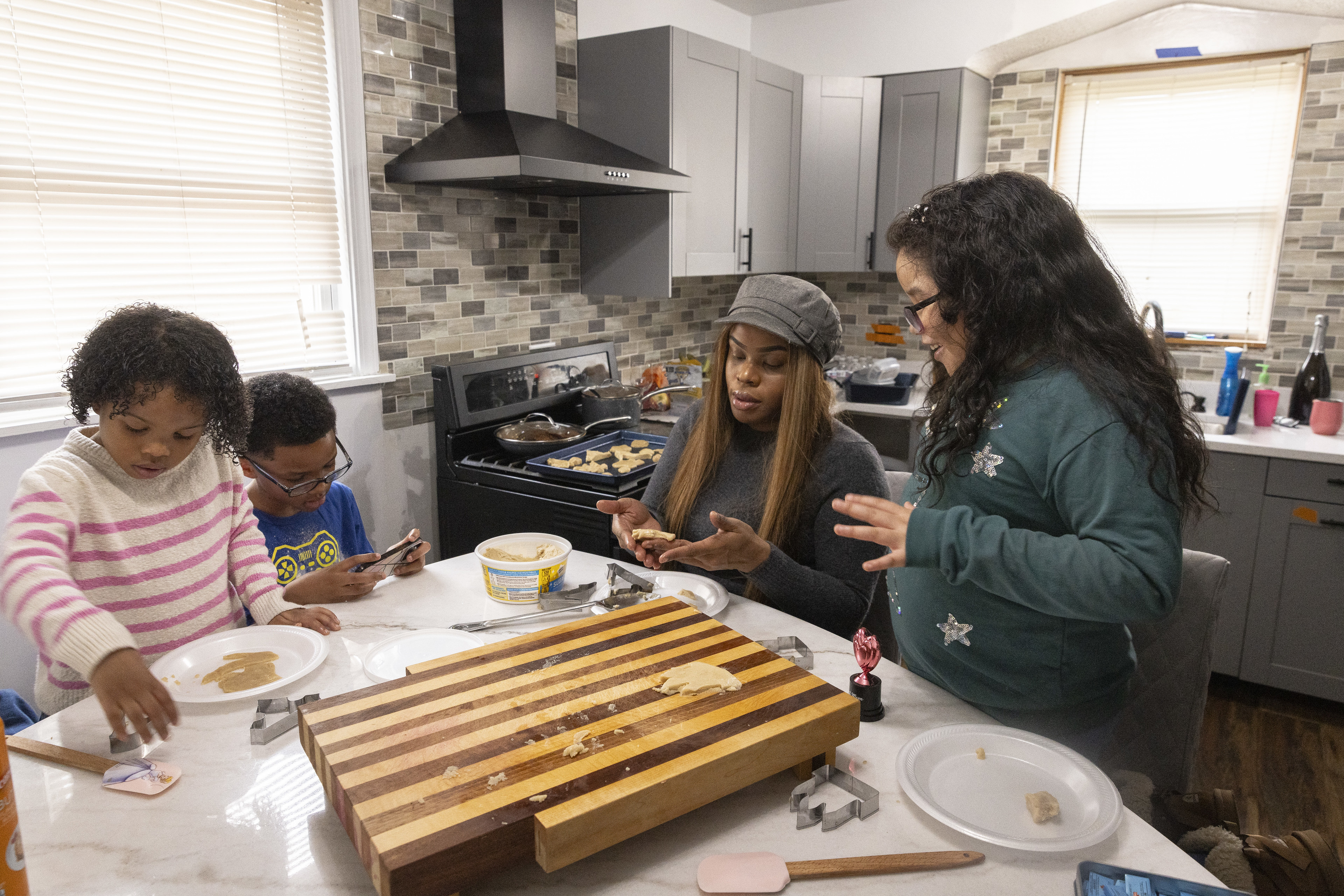
It’s a scene Robinson doesn’t want to forget.
“I want my children to know this is our home; when they have friends over, like, ‘You guys can come over to *our house,’*” she said. “There’s just something about being able to call a home just yours, and it’s really yours, like, you work for it and you pay the bills.”
But right now, she doesn’t have a home of her own. The 33-year-old currently lives with her mom in the same Southwest Side bungalow where she grew up.
It’s a catch-22 that Robinson and many single parents know well: Take a pay cut to work a job that gives you the flexibility to take care of your kids — or earn more working two jobs but spend more on child care and sacrifice time spent with family.
Robinson makes roughly $40,000 annually from her retail job, which is about $3,300 a month. After bills, taxes and a monthly child support payment, what’s left — $2,200 a month to cover rent, utilities, groceries and everything else — is barely enough to get by.
“Where can you go if you have $2,200 left a month?” Robinson said. “You can’t go anywhere.”
Like Robinson, about 129,000 renter households in Chicago — roughly one-fifth of the citywide total — make between $2,000 and $4,000 a month, according to a WBEZ analysis. About 30% of those households are spending a majority of their income on rent and utilities.
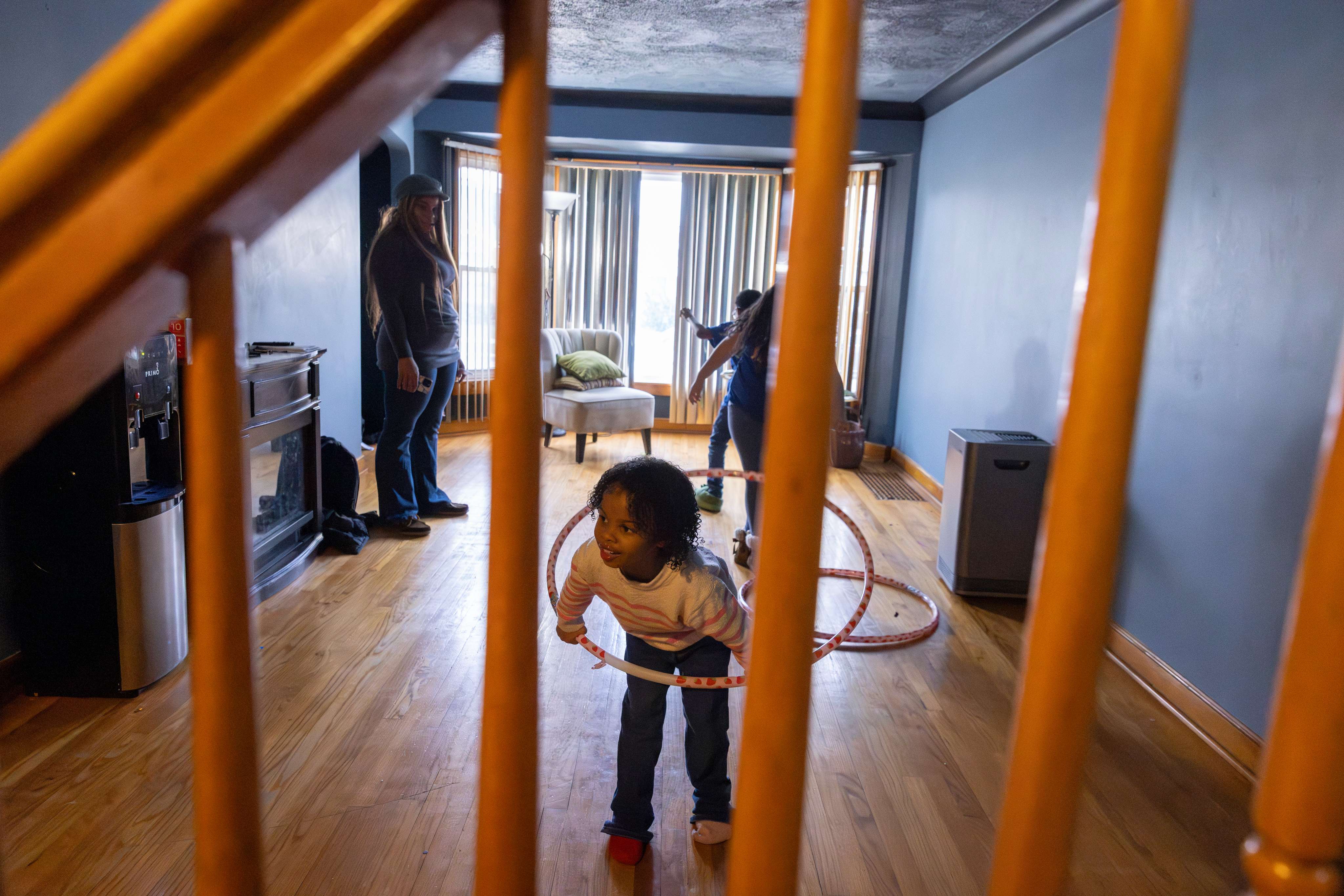
Daniel Kay Hertz, director of housing at Impact for Equity, says finding an affordable place as a lower-income renter almost always involves a trade-off.
“Unless you luck into a legally restricted affordable unit, your choices are overcrowding, spending over half your income on rent, living in a neighborhood that’s not convenient or doesn’t have the amenities you want — [or] living in substandard housing that has health and safety issues,” Hertz said.
But it wasn’t always like this.
WBEZ collected data on median rent in every Chicago community area to trace how rents have changed in the city over the past century.
A common guideline for whether an apartment is affordable is if rent and utilities make up less than 30% of a renter’s income. Spending anything more would eat into income needed to cover other basic necessities.
What we found is that Chicago has steadily become less affordable for many across a greater number of income brackets and communities, especially in the past several decades.
Why rents have gone up
Experts say there’s a clear reason for this loss of affordability.
“Rents have far outpaced incomes in the last handful of years and have risen pretty considerably,” said Alexander Hermann, a senior research associate at the Harvard Joint Center for Housing Studies.
After adjusting for inflation, Chicago’s median household income grew by just 9% from 2000 to 2023. Meanwhile, the city’s median cost for rent and utilities grew by 28%, roughly three times faster, according to a WBEZ analysis of census data.
Hermann says rents have gone up in part because more renters are competing for fewer apartments.
New apartment construction fell off dramatically in the late 2000s, in the early years of the subprime mortgage lending crisis and the Great Recession. “A number of single-family home builders [and] a number of multifamily developers left the sector all together,” Hermann said. “Less housing was built for more than a decade than we’ve seen pretty much ever.”
Fewer residential building permits issued in the Chicago metro area
Source: U.S. Census Bureau Building Permits Survey
Real estate developers are increasingly targeting renters who can afford to pay more. Data show the newest developments have come with higher price tags. The median cost for rent and utilities in Chicago apartments built since 2010 was more than $2,200, whereas the cost was $1,982 for apartments built between 2000 and 2009 and less than $1,500 for apartments built before 2000, according to data from the 2023 American Community Survey.
“[Developers] are going to build to the top of the market,” Hermann said. “That’s what they can afford to build.”
But in Chicago, the issue is more than sluggish apartment construction.
The city is also losing housing — in particular, older two- to four-unit apartments that have historically offered more affordable rents for families.
The fates of these two- to four-flats are deeply connected with patterns of gentrification and disinvestment in the city, said Geoff Smith, executive director at the Institute for Housing Studies at DePaul University.
“In high-cost areas, you’re losing [two- to four-unit buildings] to single-family homes or higher-cost condo buildings, and they’re not being replaced by other similarly affordable rental units,” Smith said.
“Over the last six months, there’s been a lot more individuals calling our hotline wanting to talk about: ‘Is this right?’ ‘Is it legal for my landlord to increase the rent $200?’ ‘I cannot pay $200 more or $500 more.’ And unfortunately, what we have to tell them is that it is legal.”
— Antonio Gutierrez, co-founder and organizer with the Autonomous Tenants Union
Smith and his team split the city into high-, moderate- and low-cost areas based on home sale prices. From 2013 to 2019, they found high-cost areas lost 7.1% of their two- to four-flats. Of those lost buildings, nearly 78% were converted to single-family homes. Most of these conversions from apartment buildings to single-family homes happened on the North and Northwest sides of the city.
“In lower-cost parts of the city, you’re seeing deterioration, leading to the loss of those units in historically disinvested neighborhoods,” Smith said.
Lower-cost areas lost 3.5% of their two- to four-flats. Of those lost buildings, more than 65% were lost to nonresidential uses. Many buildings were demolished and the lots left vacant, mostly on the South and West sides.
Newer buildings tend to charge higher rents in Chicago
Median gross rent by year the building was built
Source: U.S. Census Bureau 2023 American Community Survey (adjusted to 2024 dollar values)
Many tenants who live in existing affordable two- to four-flats also face dangerous living conditions, said Antonio Gutierrez, co-founder and organizer with the Autonomous Tenants Union, a Chicago-based tenants union that organizes renters to collectively fight for dignified and affordable housing.
In January, a 10-year old girl died from carbon monoxide poisoning in a three-story building in Albany Park. Last year, an Injustice Watch investigation found thousands of buildings in Chicago with a history of serious building safety violations.
Gutierrez also says Illinois’ decades-long ban on rent control — legislation that would cap the percentage by which landlords can increase rents — has exacerbated the city’s unaffordability and displacement crises.
“Over the last six months, there’s been a lot more individuals calling our hotline wanting to talk about: ‘Is this right?’ ‘Is it legal for my landlord to increase the rent $200?’ ‘I cannot pay $200 more or $500 more.’ And unfortunately, what we have to tell them is that it is legal,” Gutierrez said.
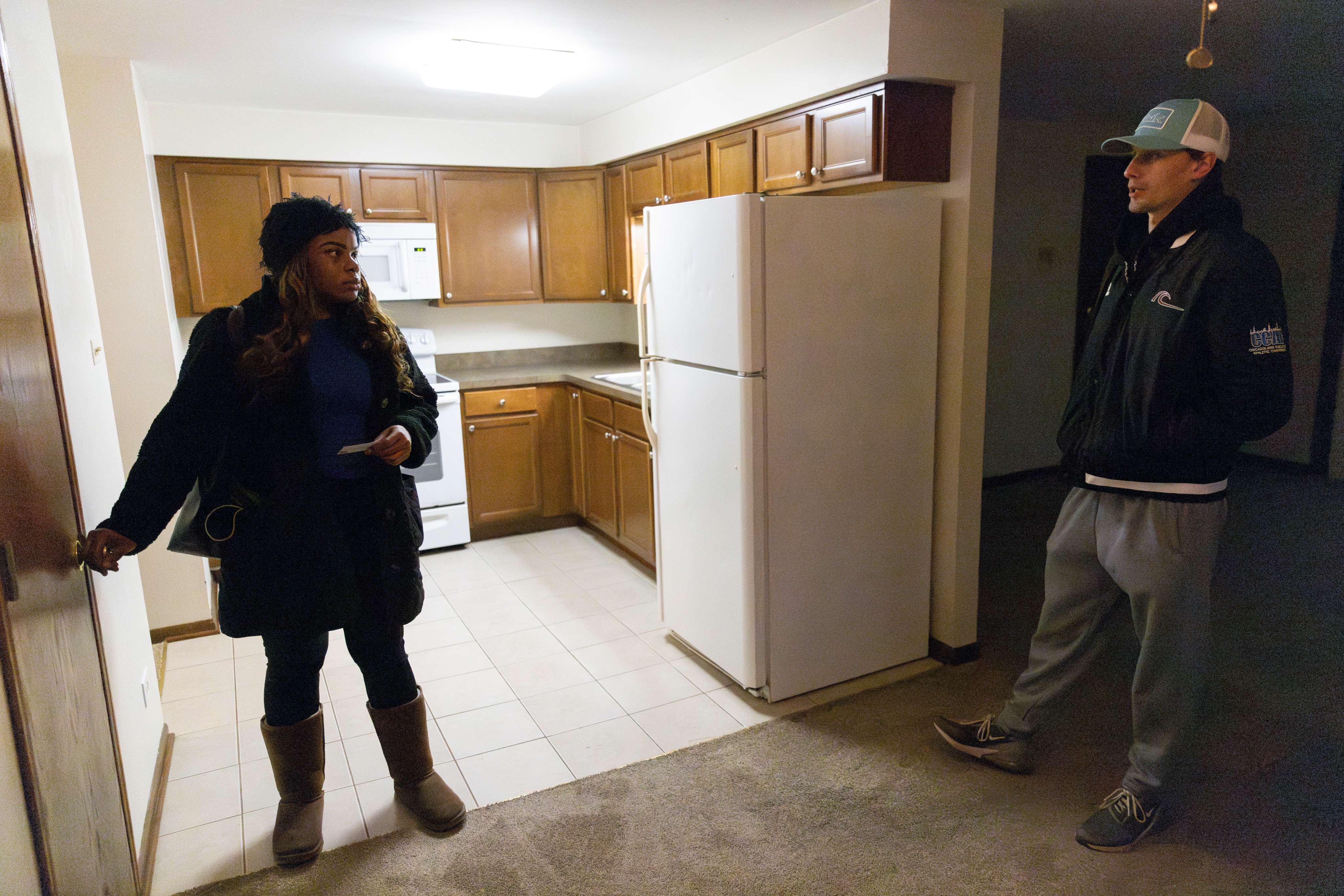
“These rent increases are very common in our work; we’ve seen double, even triple, the amount of what people were originally paying,” Gutierrez said.
Despite several efforts in the Illinois legislature over the last few years to repeal the ban on rent control, they’ve all stalled in committee. Most recently, this February, state Rep. Lilian Jiménez reintroduced a bill that would allow local governments to hold a referendum to opt out of the rent control ban.
Neighborhoods completely out of reach
Letonia Robinson drives around Ashburn in search of “For Rent” signs just about every week.
The quiet South Side neighborhood where Robinson grew up is nestled between Marquette Park and southwest suburban Evergreen Park.
She wants to stay in the neighborhood. Her mom is getting older, and she wants to live close by. Robinson’s two daughters also go to the same Ashburn school she attended many years ago; she wants to keep her daughters there.
“I’ve been familiar with this area my whole life, and to see it drastically change like this, with rent going so high, it’s just very devastating.”
— Letonia Robinson
Twenty-five years ago, a majority of the apartments in a dozen neighborhoods would have been affordable for someone making about half the city’s median income, like Robinson. They would have included North Lawndale, South Lawndale, the Lower West Side, the Near South Side, Douglas, Grand Boulevard, Washington Park and Woodlawn. Now, a majority of the rents in those eight neighborhoods are completely out of her reach. For example, after adjusting for inflation, the median rent in the Near South Side community has nearly quadrupled since 2000.
On a recent drive through Ashburn, she points to a group of low-slung yellow-brick apartments off Kedzie Avenue.
“These apartments over here, they were like $1,000, but now I think they have a new owner, so these are like $1,700 for a one-bedroom,” Robinson said.
A few blocks down, a similar apartment complex has bumped monthly rent up by $200 since the last time she checked.
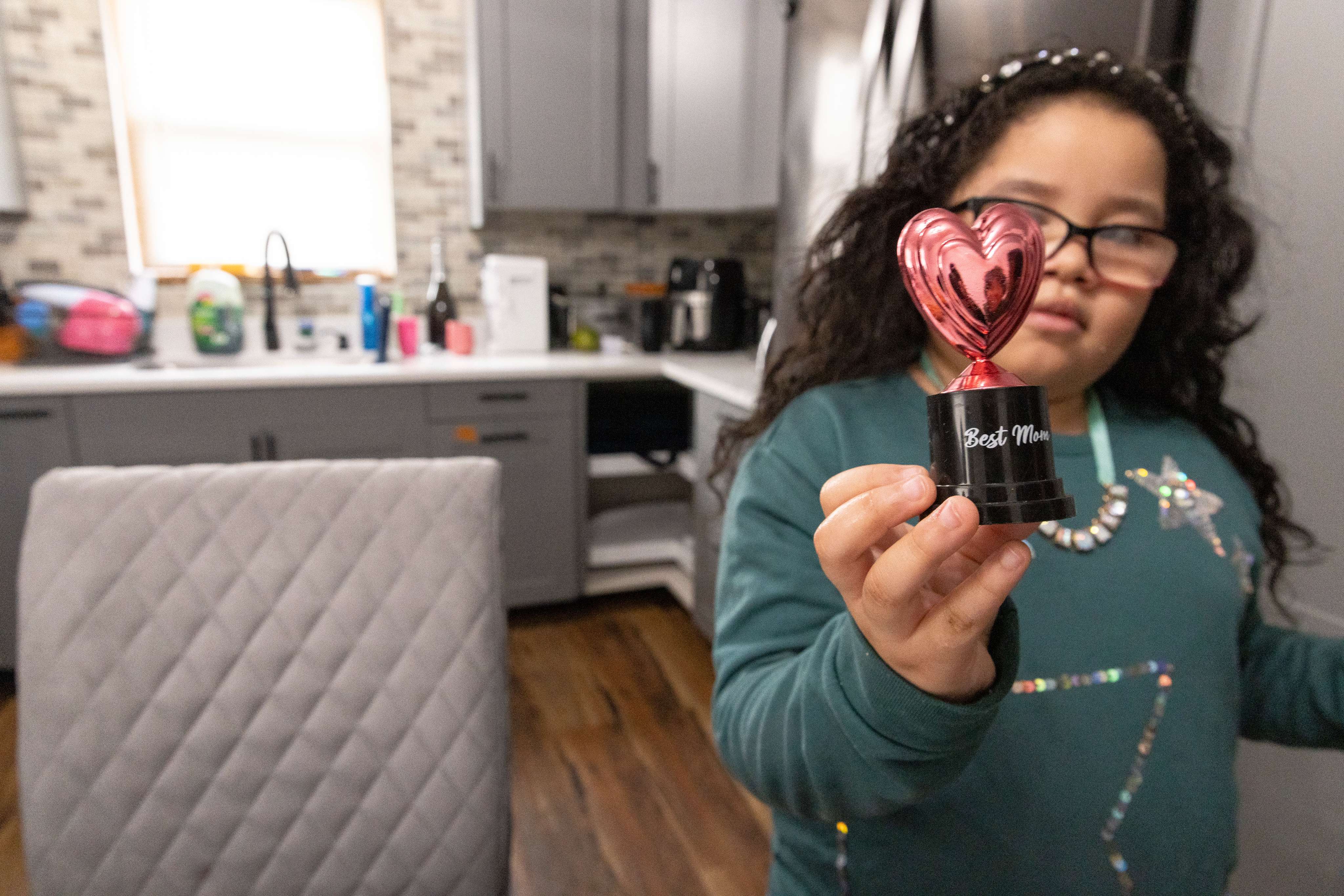
“I’ve been familiar with this area my whole life, and to see it drastically change like this, with rent going so high, it’s just very devastating,” she said.
Sometimes Robinson thinks about leaving Chicago for somewhere more affordable in the suburbs or even another state.
“I know a friend that relocated to Dallas, Texas, and she pays like $1,300 for a three-bedroom, two-bathroom [apartment],” she said.
If she could find an affordable place, maybe she could finally save up for flights to Virginia with her two girls. She really wants to surprise her son Jaycee Riley for his 9th birthday.
For now, she’s giving herself one more year to find a place close to home. But she’s starting to look elsewhere.
Robinson recently put herself on an affordable housing waitlist in Fort Lauderdale, Fla.
She’s currently 865th on the list.
via http://www.wbez.org https://www.wbez.org
March 1, 2025 at 03:34PM

