
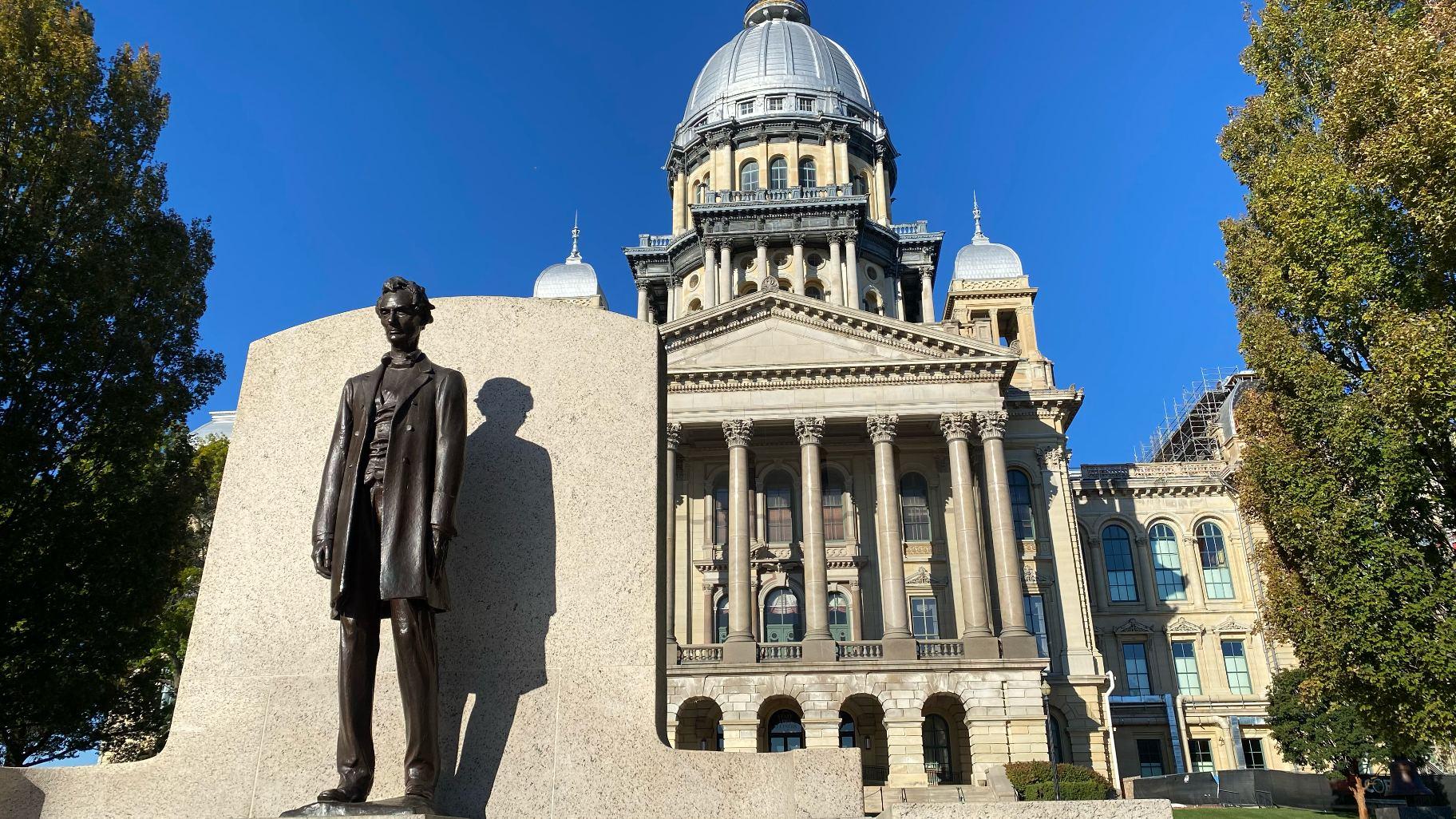
 The Illinois State Capitol is pictured on Oct. 15, 2024. (Nick Blumberg / WTTW News)
As a committee of state lawmakers wraps up a series of hearings on transit, their focus broadened to public transportation issues around the state – but still with an eye toward the fiscally challenged Chicago area and the proposed governance changes many lawmakers say must happen in order for the General Assembly to come through with more money.
The Illinois Senate’s Transportation Committee has been meeting since July to grapple with the thorny issue of funding for the Chicago area’s transit system and whether to replace the CTA, Metra, Pace and Regional Transportation Authority with a single agency that will oversee bus, train and paratransit services. The proposal also calls for $1.5 billion in new funding – but at a Tuesday hearing, transit leaders from other parts of Illinois asked lawmakers to ensure their systems don’t lose out on the state funding they badly need.
“Illinois is a leader in this regard, so I want to thank you for that,” said Karl Gnadt, managing director of the Champaign-Urbana Mass Transit District. But he added that it’s still a challenging time for public transportation systems – citing the safety concerns and stress facing drivers, who he said need resources to support them. “We need to provide resources to them, and all of that costs money. I know that’s all you hear is, ‘we need more money’ – but we need more money.”
Money was also top of mind for John Coultas of the Illinois Municipal League, an advocacy organization for local officials.
“Legacy financial obligations and debt, including CTA pension liabilities, should not be passed on to other constituent groups,” Coultas said. “This would result in significant increases in pension costs to the other boards … a less drastic approach to governance reform should be considered.”
Coultas echoed the concerns about representation from the collar county executives that his organization works with, as well as calls to continue funding smaller transit operators around the state. Asked whether the Illinois Municipal League and its members are supportive of an alternative governance reform that’s been pitched – a strengthened RTA with new mandates to coordinate things like service delivery and fare policy – he said the organization doesn’t have an official position but that “from our perspective that is a better option.”
Other advocates say given the impending fiscal crisis, and what they say as management shortcomings in the current transit system, it’s time to take bolder steps.
“This is really a moment of reform … I think it’s pretty obvious. I don’t know what else you need to see,” said Tom Kotarac with the Civic Committee of the Commercial Club of Chicago, an organization representing business interests that’s backed the idea of a merger.
Many lawmakers involved in the process have acknowledged that coming up with an extra $1.5 billion in annual funding will be a big lift, and haven’t yet proposed specific sources. At Tuesday’s hearing, they heard some ideas that could help generate extra transit cash.
The Chicago Metropolitan Agency for Planning report that floated the idea of merging the separate transit agencies and juicing them with extra funding laid out some ways to come up with the money – among them, a city vehicle registration surcharge and a parking tax. But Mary Tyler, transportation director of the Illinois Economic Policy Institute, said the revenue those would generate is a “far cry” from what’s needed.
Her organization’s been studying an idea long discussed in Springfield – expanding the state sales tax to cover services. While she acknowledged that “there are a lot of variables that need to be considered,” she said it’s an idea worthy of consideration.
While the series of Senate hearings are done for now, there’s also a closed-door working group of House lawmakers tackling the issue at the direction of House Speaker Emanuel “Chris” Welch. And despite objections from transit leaders and pushback from some advocates and local lawmakers, state senators on Tuesday appeared to be keeping their sights on governance.
“The RTA board has never had the legal authority to force (CTA, Metra, and Pace) to coordinate, and I believe that is the key in this entire MMA reorganizational process,” said the committee’s minority spokesperson, state Sen. Don DeWitte (R-St. Charles). “An empowered restructuring of the RTA is needed. I think everybody agrees on that.”
The committee chairman, state Sen. Ram Villivalam (D-Chicago), echoed that focus. He called on the CTA, Metra, and Pace to provide more detailed plans for how they’d deploy additional state funding, whether it’s merely enough to cover their looming shortfall or the additional windfall under consideration.
“I would say almost unequivocally that no one is calling for the status quo in terms of governance,” Villivalam said.
Contact Nick Blumberg: nblumberg@wttw.com | (773) 509-5434 | @ndblumberg
via WTTW News https://news.wttw.com
October 15, 2024 at 04:57PM

