
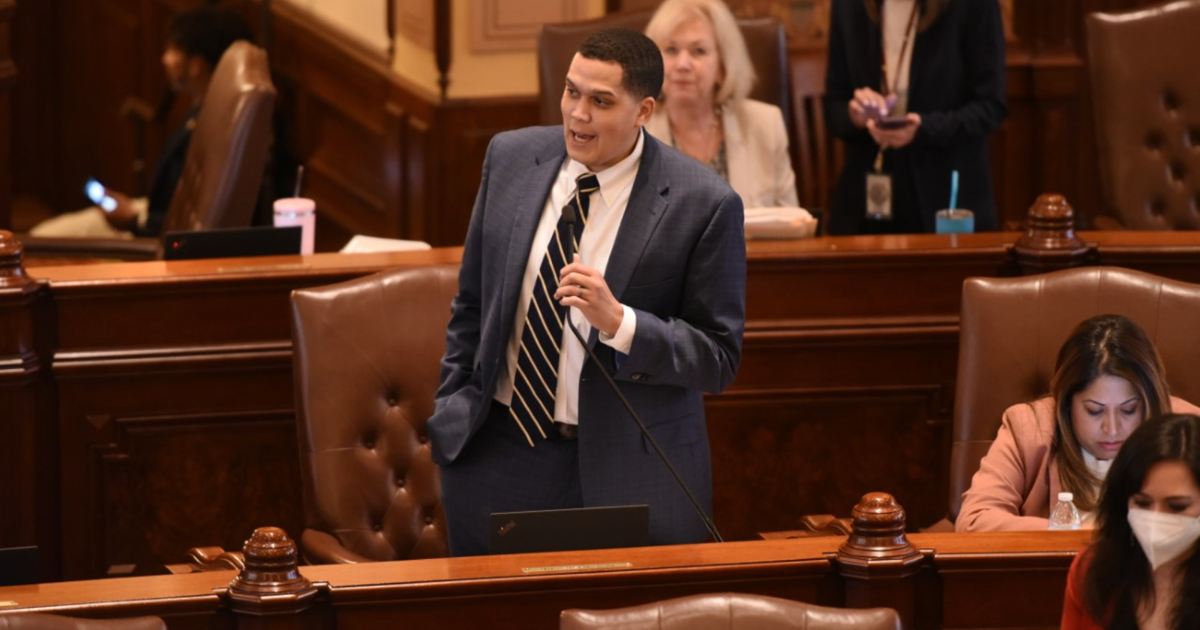
This week in Springfield, lawmakers wrapped up their final legislative session of 2023. The veto session has seen legislators deliver major legislation in years past, but this year legislators stalled on several major initiatives — Karina’s Bill, the “Right of First Refusal” and the staff unionization bill — pushing those off to next year’s agenda.
The Herald spoke with local state Sen. Robert Peters (D-13th) for an in-depth perspective on the six-day, two-week session, and for a preview of his legislative priorities for the coming year.
Nuclear energy moratorium ends
After an initial veto by Governor J.B. Pritzker, a revised bill ending Illinois’ 36-year-old moratorium on the construction of new nuclear power plants has passed.
Pritzker said he vetoed the first bill earlier this year because there were not enough “regulatory protections for the health and safety of Illinois residents.”
Peters said he supported Pritzker’s veto because he principally opposed building large-scale reactors. He is, however, open to the revised version of the bill allowing for the construction of some small-scale nuclear reactors.
“We need to be able to transition off of coal and oil,” he said. “If this is a way for us to get there, that would be very helpful.”
Currently, Illinois has 11 nuclear power reactors operating at six sites, which collectively produce about half of the state’s electricity.
That revised bill, which comfortably passed in the Senate, also garnered overwhelming support in the House on Thursday and is expected to be signed into law by Pritzker soon. Construction of the new modular nuclear reactors could begin as early as January 2026.
“Right of First Refusal”
Peters opposed a bill introduced by Rep. Larry Walsh (D-86th) that would have offered in-state utilities the “right of first refusal” for lucrative transmission line construction contracts.
“Ameren Illinois would have very much benefited from this,” he said. “(But) I don’t want to say it’s simply (about giving them) a monopoly.”
He said the bill was not simply a concession to powerful downstate utility companies, noting, for instance, that International Brotherhood of Electrical Workers, one of the state’s largest unions, was also a major supporter of this bill.
Two weeks ago, the bill’s sponsors conceded that they did not have enough support to override Pritzker’s veto but vowed to bring a revised version of the bill back up next spring.
Invest in Kids
In spite of intense pressure from Republicans and school-choice advocates who descended on Springfield to voice their support, lawmakers wrapped up the veto session without extending the Invest in Kids tax credit program, which provided indirect state support to children attending private and religious schools.
The program, which allowed donors to six-state approved private school scholarships to claim a 75% income tax credit on their donations, capped at $75 million a year.
“I am not a fan of Invest in Kids,” Peters said. “I am a believer that public schools need to be fully publicly funded and that it is the public’s responsibility to do so.”
A concession bill proposed by state Republicans would have lowered the cap to $50 million for the next five years, but it did not come up for a vote. The program will sunset on Dec. 31.
“If donors or rich people really care about this, they can just give the kids the money to go to these schools. It doesn’t need to be a tax write-off for them,” Peters said.
While supporters of the bill said it produced nearly 40,000 scholarships, many going to Black and brown children, Peters said the data from the Department of Revenue does not back up that talking point.
“I don’t think I have any Black people at any one of these Catholic schools who were benefiting from Invest in Kids. At the same time, I’m being told that it’s helping Black people,” he said. “I think this is a classic example of a bunch of people seeking a tax credit, and (private) institutions who are doing whatever they can to increase enrollment.”
Karina’s Bill
While Peters and domestic violence prevention advocates wanted the Senate to swiftly pass a bill aimed at removing guns from people accused of domestic violence, Senate president Don Harmon (39th) dashed their hopes when he announced on Tuesday that there were still issues to work out that would have to wait till next year.
Named after Karina Gonzalez, the Little Village woman who was shot dead by her husband after getting a court order of protection against him, “Karina’s Bill” would require judges to issue a seizure order along with orders of protection, while also mandating that law enforcement serve those orders and seize weapons within 48 hours.
“I’m sick and tired of hearing about people who supposedly care about victims and supposedly care about safety, not supporting a bill that is rooted in survivors and victims of violence and rooted in safety,” Peters said. “Here’s a real big slam dunk when thinking about a survivor-first policy around public safety. So, I hope (it passes eventually).”
Staff unionization
Legislators will also have to pick up a bill next year to allow legislative staff members to unionize. Championed by the staff of House Speaker Emanuel Welch (7th) and passed through that chamber in the first week of the veto session, the bill stalled out in the Senate.
“Supporting anybody who’s working, whether it’s in Springfield or anywhere else, I think that’s something that we have to do,” Peters said. He remains supportive of the effort but said that the lack of time to analyze the bill was an issue.
“We need to actually be able to review this language, everything from who actually falls under the union to making sure it’s constitutional, the whole shebang,” he said.
New items for next year’s session
Looking to next year’s spring legislative session, Peters said he is working on a bill to ensure that all young people have legal representation whenever they are interrogated by police.
Under current state policy, police are required to contact parents when questioning a minor, but it is their choice whether to request counsel or not. A 2017 law does require that a lawyer be present throughout the interrogation of a minor suspected of murder or sexual assault, but only for those younger than 15.
In August, WBEZ uncovered video evidence showing how a detective convinced a 15-year-old in Waukegan into falsely confessing to shooting he did not commit.
“I carried the ban on lying (and) deception in interrogations,” Peters said, referring to the 2021 law banning police from using deception on youth. “But we now need to ensure that juveniles or young people being interrogated have representation.”
He also stated that he is working on a bill to enhance workers’ protections and their rights around organizing and collective bargaining.
Given Democrats’ control of the state’s executive branch as well as House and Senate, he expects there to be continued passage of landmark progressive legislation like 2021’s Safety, Accountability, Fairness and Equity-Today (SAFE-T Act), which abolished cash bail among other significant criminal justice reforms.
“We’re a triple-D state that’s been going strong and doing amazing historic things, and I don’t see that slowing down,” he said.
Ino Saves New
via rk2’s favorite articles on Inoreader https://ift.tt/cjVzrfG
November 10, 2023 at 10:51PM
 Illinois Delivered