
By Ted Cox
Ahead of the warmest day of the year expected Tuesday, the governor and the state’s leading health officer urged Illinoisans to stay home and “protect each other” by not spreading the coronavirus.
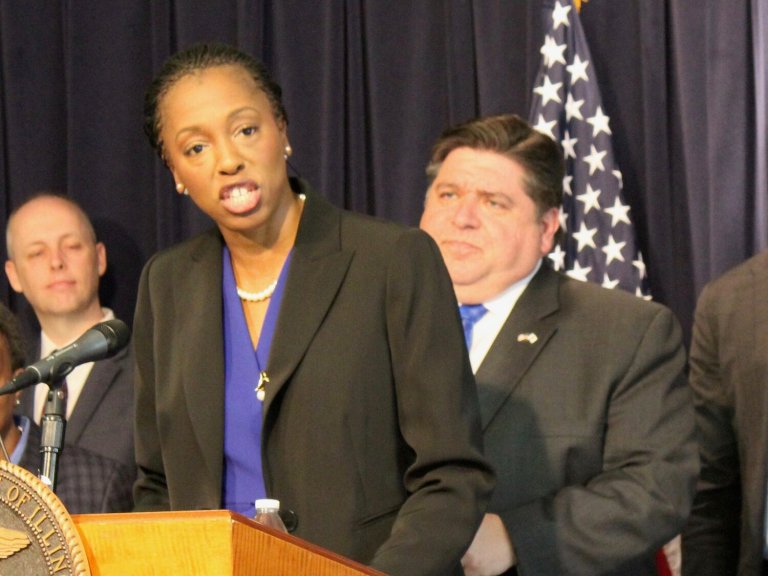
Dr. Ngozi Ezike, director of the Illinois Department of Public Health, began her remarks at the daily coronavirus briefing Monday at the Thompson Center in Chicago with “a few words of caution. The forecast says that tomorrow will be our warmest day in many areas of the state. Please stay home. I assure you, if people congregate tomorrow we will set the state back in our fight against COVID-19.”
Ezike went on to say that the state had confirmed 1,006 new cases of the coronavirus Monday, bringing the statewide total to 12,262. Some 33 new deaths brought the Illinois toll to 307.
“I hope that people listen to Dr. Ezike about the weather tomorrow,” added Gov. Pritzker. “Do not go meet people. Do not.”
Pritzker emphasized that should continue through Passover on Wednesday and Easter Sunday, saying, “Look, I understand the desire to worship. Passover is coming up. We’re in Easter week. This is a holy time of year. And I want very much for people to experience the spirituality that they normally would. We live in a very difficult time, and I would suggest that unfortunately we all should start to think about how we’re going to use technology in order for us to to gather, in order to hear our pastor or our rabbi or our imam or whoever we worship with — to listen to them and to worship online, perhaps by video or by phone, and to connect with family in the same way.”
Adding that he’d heard people planning to hold a Passover seder over the Zoom teleconferencing website by referring to it as a “zeder,” he said, “I think we’re all going to be experiencing the holidays in a very unusual way this year.” But he stressed the urgent need to avoid spreading the virus, saying, “We’ve got to protect each other.”
Pritzker and Ezike held the briefing just as Chicago was releasing new figures showing that COVID-19 was hitting especially hard in the city’s African-American community. According to city health data, 1,824 African Americans, 847 white residents, 478 Hispanics, and 126 Asian Americans had been diagnosed with COVID-19 through Sunday. African Americans make up 30 percent of the city population, but had accounted for 72 percent of the city’s coronavirus deaths.
“This new data offers a deeply concerning glimpse into the spread of COVID-19 and is a stark reminder of the deep-seated issues which have long created disparate health impacts in communities across Chicago,” Mayor Lori Lightfoot said. “While this data is extremely troubling, we are determined to lessen the impact of COVID-19 by engaging communities that have traditionally been overlooked and that have suffered disinvestment and neglect for generations. Data and science have been a critical tool in our public health response to COVID-19 from day one, and we will continue to rely on them to move resources where they are needed most. We know that our residents’ health is impacted by a number of factors, and we will also be taking a critical look at ways we can ensure that every Chicagoan has the opportunities and resources necessary to maximize their health and well-being.”
“That’s a product of generations of systemic disinvestment in communities of color,” Pritzker said, “compounded by the disparities in health-care delivery systems and access.
“Here’s the reason that we think that it has a disproportionate effect on the African-American community,” he added. “Underlying conditions that exist, the poor health care that has been provided because of years of disinvestment in communities of color — those have both come together. This virus has had this terrible effect on the African-American community because of those two things. … We are countering it, both by reopening hospitals that are in those communities,” such as Westlake Hospital in Melrose Park and MetroSouth Medical Center in Blue Island, “as well as making sure that we’re messaging properly,” using social media and the All in Illinois campaign to reemphasize preventive measures.
Ezike pointed out that 70 percent of COVID-19 deaths have involved people with pre-existing conditions such as high blood pressure, diabetes, and heart disease — all of which are more prevalent in the African-American community due to a historic failure, economic and social, to address chronic disease and its causes.
26-Delivered
via 1IL
April 6, 2020 at 05:31PM
 Illinois Delivered