
By George Alexandrakis
Medill Reports
EVANSTON — Standing along a frigid Evanston street on Martin Luther King Jr. Day, lifelong Evanston resident Clif Brown held up a Palestinian flag and wore a two-sided sign opposing two of the leading contenders in Illinois’ 9th Congressional District Democratic primary.
“It’s very cold, and I was kind of curious to see if I could stand in this very cold weather,” said Brown, as temperatures hovered around 8 degrees. “I’ve been doing this for about 15 months now, it’s almost daily.”
Brown, 75, said he was protesting the involvement of pro-Israel political organizations in the race and to draw attention to the fact “outside money is shaping (the election), and voters deserve to know that.”
That outside money has since become the defining controversy in the race.
The 9th District race to replace retiring Rep. Jan Schakowsky (D-Ill.) has also drawn increased attention to Illinois because of national issues impacting the state, notably immigration, because one of the candidates, Kat Abughazaleh, was indicted for alleged interference in ICE operations in Broadview.
It has also seemed higher profile for its mix of establishment-backed and progressive candidates, which is raising questions about what kind of Illinois Democrat voters want to represent them.
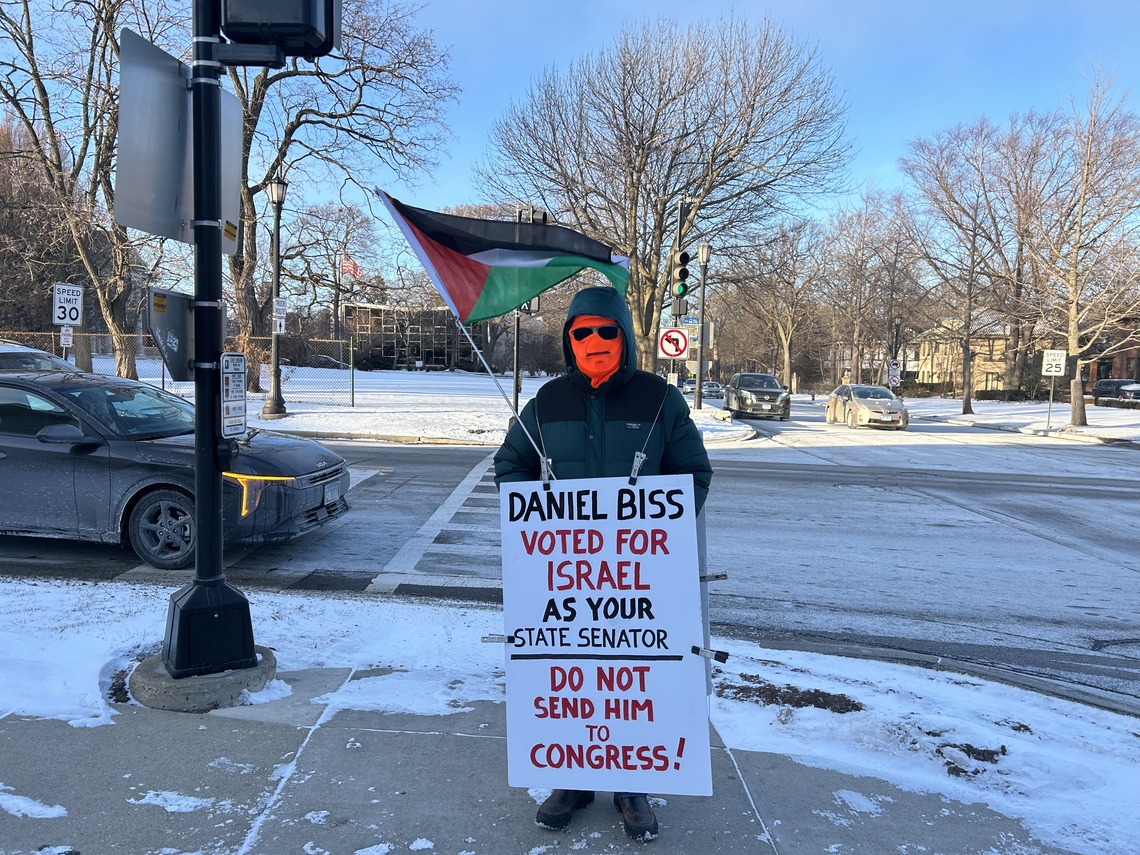
Clif Brown, 75, holds a Palestinian flag and a two-sided sign opposing candidates in the 9th District Democratic primary in Evanston.“Everything I’ve seen from Kat has been encouraging. … It’s all without PAC money, and she’s equaling (Evanston Mayor Daniel) Biss in fundraising … so that’s a good thing,” Brown said.
Brown’s protest coincided with a growing debate over the role of political action committees in the crowded Democratic primary fraught with local issues such as housing affordability and loss of federal funding to the Chicago area’s transportation system.
Among the most closely watched developments in the race has been Schakowsky’s endorsement of Biss, a former state legislator, as well as the involvement and relationship of the American Israel Public Affairs Committee with each of the candidates — a relationship that has only intensified, with AIPAC-linked super PACs spending more than $5 million in the district alone.
The Democratic Party of Evanston, which held a vote to determine if it would endorse any of the candidates in the primary election, ended up not endorsing any Democrat across any statewide election after their two-thirds majority requirement was not reached.
Despite not receiving two-thirds of the vote nor the DPOE’s endorsement, Biss received 53% of the vote among the members. State Sen. Laura Fine, D-Glenview, received 17% of the vote, and progressive candidate Abughazaleh, a journalist, was in third with 10%. The remaining 20% was split among the other 14 candidates in the field.
AIPAC, the third-highest spending PAC in the 2024 election cycle and through affiliated super PACs including “Elect Chicago Women,” has poured millions of dollars into the race supporting Fine while labeling Biss and Abughazaleh as “dangerous detractors.”
When asked about AIPAC’s role in the primary, Biss said voters should be wary of national organizations attempting to shape the outcome of state elections.
“I think the voters want somebody who knows our community and is supported by our community, and is not supported by outside special interests, who’s funded by people in this community, and is responsive to people in this community,” Biss said. “I think everybody should be transparent about where their support comes from and why, and I wish every candidate were doing that like I am.”
Abughazaleh is running a grassroots campaign and has focused her effort on her progressive stances and fundraising without PAC support. Supporters, like Brown, argue her approach is demonstrating the strength of local support in the race and that it contrasts with her opponents’ connections to outside organizations and support.
Abughazaleh was indicted by a federal grand jury for her alleged participation in a protest Sept. 26. The indictment alleges Abughazaleh, along with five other people, were “banging aggressively on the government vehicle … and pushed against the vehicle to hinder and impede its movement.” But March 12 — just days before the primary — federal prosecutors dropped the charges against two of the defendants, Catherine Sharp and Joselyn Walsh. The trial for the remaining four defendants, including Abughazaleh, is still moving forward and scheduled for May 26.
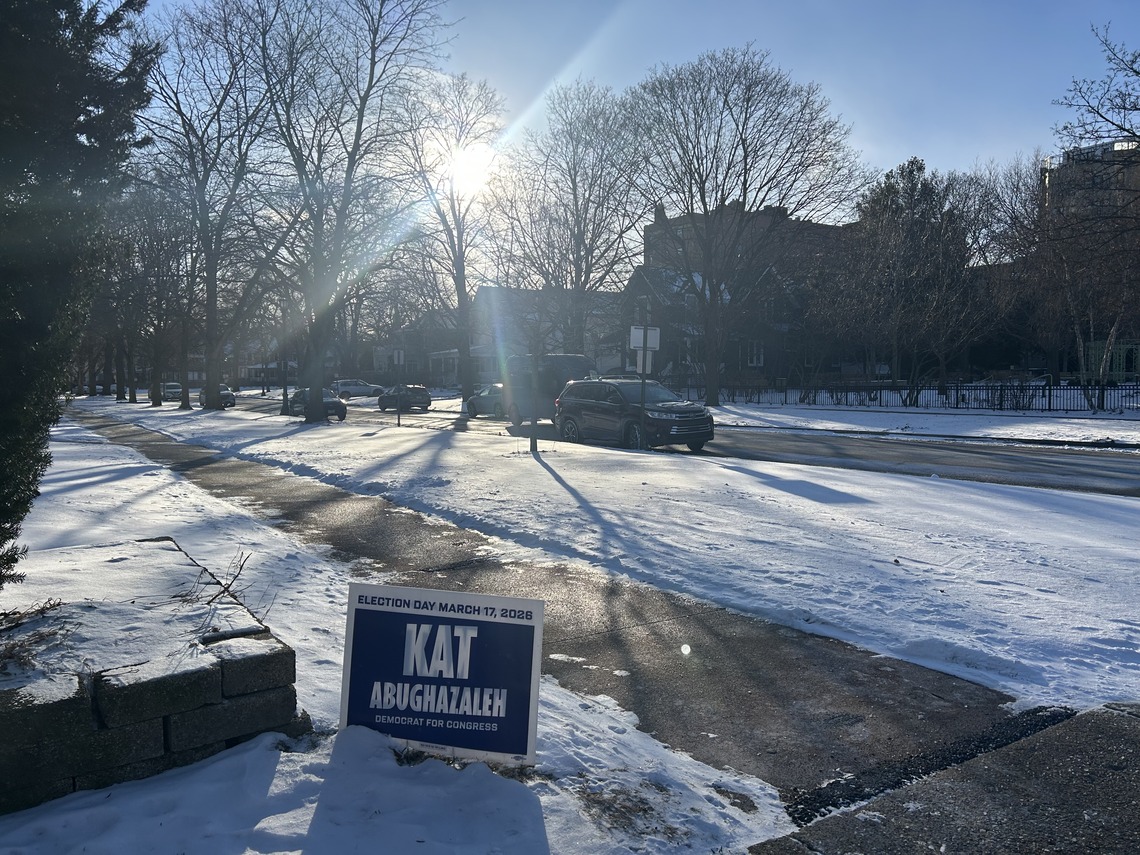
The candidates’ campaigns are also increasingly visible through TV advertising, with the candidates attempting to cast a wide net to reach as many different types of voters as possible.
“Aren’t you sick of out-of-touch career politicians not understanding the moment we’re in?” Abughazaleh’s recently released ad begins.
“I’ve taken on corporate polluters, banned assault weapons and guaranteed abortion rights,” Fine said in her recently debuted ad, touting her actions as state senator.
“Some politicians just talk, but I took the streets with you, while working for you as mayor,” Biss said at the beginning of his main ad, partially speaking over a clip from a viral video of him confronting immigration agents during an operation in Evanston.
The most recent polling shows a tight race, with one survey conducted March 9-10 by Public Policy Polling finding Biss leading at 24%, Abughazaleh close behind him at 20% and Fine falling to 14%. State Sen. Mike Simmons, also in the race, reached 10% in the poll — the first candidate outside the top three to hit double digits. One notable entry: 17% in that poll said they didn’t know whom they were voting for yet.
Research conducted by political scientists shows while endorsements and outside funding can shape a race’s rhetoric, they may not always fully reflect the issues that matter most to primary voters. Laurel Harbridge-Yong, a political science professor at Northwestern University, conducted a survey during the 2024 presidential election primaries to see which issue mattered most for both Democratic and Republican voters.
“Despite the conflict in the Middle East being something that was high on the radar of political elites, it was not something that was a high priority among primary voters,” Harbridge-Yong said. “For Republicans, it was immigration. … For Democrats, it was economic and social issues. … Voters cared a lot more about what’s happening in this country than they do about foreign policy.”
For Biss, that meant emphasizing local governance and community issues such as transportation and housing.
“We are a district that’s reliant on mass transit, and Donald Trump is slashing funding to the CTA,” Biss said. “We fought as much as we are able to at the municipal level and under my time as mayor, but the federal government needs to step up.”
Fine and Abughazaleh have also highlighted domestic priorities in their campaigns, with a significant portion of their websites and television ad airtime focusing on fighting federal immigration enforcement operations in Chicago and Evanston.
The campaigns of both Abughazaleh and Fine were contacted for comment, but no response was received before publication.
The Democratic primary for Illinois’ 9th Congressional District will be held Tuesday. The full list of candidates on the ballot in alphabetical order is: Kat Abughazaleh, Bushra Amiwala, Phil Andrew, Daniel Biss, Patricia Brown, Jeff Cohen, Laura Fine, Justin Ford, Mark Fredrickson, Hoan Huynh, Bethany Johnson, Sam Polan, Nick Pyati, Howard Rosenblum and Mike Simmons.
George Alexandrakis is a politics, policy and foreign affairs specialization graduate student at Medill.
Feeds,College,City: Evanston
via Medill Reports Chicago https://ift.tt/3o12IBS
March 16, 2026 at 10:40AM
 Illinois Delivered