
“I may be poor …” began the call-and-response Rev. Jesse Jackson led in various forms before rapt audiences for more than half a century. “But I am … somebody! I may be on welfare. But I am … somebody! I may be in jail. But I am … somebody! I may be uneducated, But I am … somebody. I am Black. Beautiful. Proud. I must be respected. I must be protected. I am … somebody!”
That, in essence, is the message Rev. Jackson devoted his life to championing — for Black people in general and himself in particular. From leading Rev. Martin Luther King Jr.’s open housing campaign in Chicago in 1964, through his close association with the great civil rights leader during the last three years of King’s life, to the tumultuous 1970s, when Jackson started what became the Rainbow PUSH Coalition, to the 1980s, when he ran the first viable presidential campaign by a Black candidate in the United States, to the 1990s, when he traveled the globe, to free hostages, advise leaders, join picket lines and lend his internationally famous name to often desperate causes. To his later years, when he settled into the role as a revered elder statesman of Black Chicago and an unceasing voice for social justice.
Rev. Jackson died at age 84 on Tuesday, the family said in a statement. He had been in declining health for a decade; in 2017 he announced he had been diagnosed with Parkinson’s disease two years earlier, but last April revealed that it was actually misdiagnosed progressive supranuclear palsy, a condition also affecting bodily movements. He stepped down as president of PUSH in July 2023, citing health concerns. Rev. Jackson appeared onstage at the Democratic National Convention in Chicago in August 2024, when he was presented to the crowd after a video celebrating his life, but did not speak.

If the legend of his mentor, Martin Luther King was simplified, almost beatified, by early death — a martyr at 39, an icon who had a dream — then the legacy of his eager protege was complicated by long life. Rev. Jesse Jackson was in the public eye for six decades, a tireless wielder of social pressure. He was respected and dismissed, inspiring adoration and disdain, a Chicago institution who left footprints on the world stage, an ardent advocate for civil rights whose attempts to wield political power himself were thwarted, and channeled into the power of protest, persuasion and complaint.
”Yet, there are doubts and criticisms raised about this complex man, a man characterized by ambiguity and contradiction,” the New York Times magazine wrote about him in 1972. “He is a brilliant speaker, a skilled mobilizer. He is also vain and self-seeking, a star, a man of great ambition, a man who, at times, uses the tricks of a demagogue.”
Which is another way to describe a powerful orator who inspired and uplifted millions of people, whether one-on-one or through the media he played skillfully around the world. In everything he did, Jackson was always pushing to be counted and make a difference. To be somebody.

Dominique Jones broke down in tears and hugged Rev. Jesse Jackson while talking about how her cousin, 17-year-old Stevie Jefferson, was shot to death on Jan. 4. Jones, Jackson and hundreds of people joined Cardinal Blase Cupich, Archbishop of Chicago, for a Walk For Peach and traced the Stations of the Cross through Englewood on Good Friday, April 14, 2017.
He was born under highly unpromising circumstances, on Oct. 8, 1941 in Greenville, South Carolina, in a three-room, tin-roofed house without running water. His mother was an unwed 16-year-old high school student named Helen Burns. His father, Noah Robinson, was a married neighbor more than twice her age — 33 — with three stepchildren.
When Jesse was a toddler, his mother married Charles Jackson, who adopted Jesse when he about 12. Charles Jackson worked as a janitor, and sometimes young Jesse would help him clean buildings.
It was a deeply segregated time and place. When baseball star Jackie Robinson came to Greenville for the NAACP, he wasn’t allowed to use the bathroom at the airport. Young Jesse was taunted for his stammer, which would return in moments of excitement later in life. His mother was his first adoring audience. She always told him, Rev. Jackson later recalled: “You’re going to be somebody. Just hold on.”
His calling came early.
“Jesse was an unusual kind of fella, even when he was just learning to talk,’’ Robinson remembered. ‘’He would say he’s going to be a preacher. He would say, ‘I’m going to lead people through the rivers of water.’‘’
As a teen, Jackson arrives in Chicago
Jackson was drawn to Chicago by an uncle, Henry Williams, who lived at 61st and Vernon and worked at the U.S. Postal Service’s Englewood station, but often returned south.
”He would travel back home in the summertime to visit,” Rev. Jackson wrote. “After his stay, we went with him to the station and it was so sad when the train would pull off … how we desperately wanted to accompany him … bound for Chicago.”
He got his wish at 15, when he was put on the train to Atlanta, fortified with his mother’s ham sandwiches, hard-boiled eggs, sweet potato pie and a jug of lemonade.
”God,” he thought, arriving at the 63rd Street station. “I am in Chicago.”
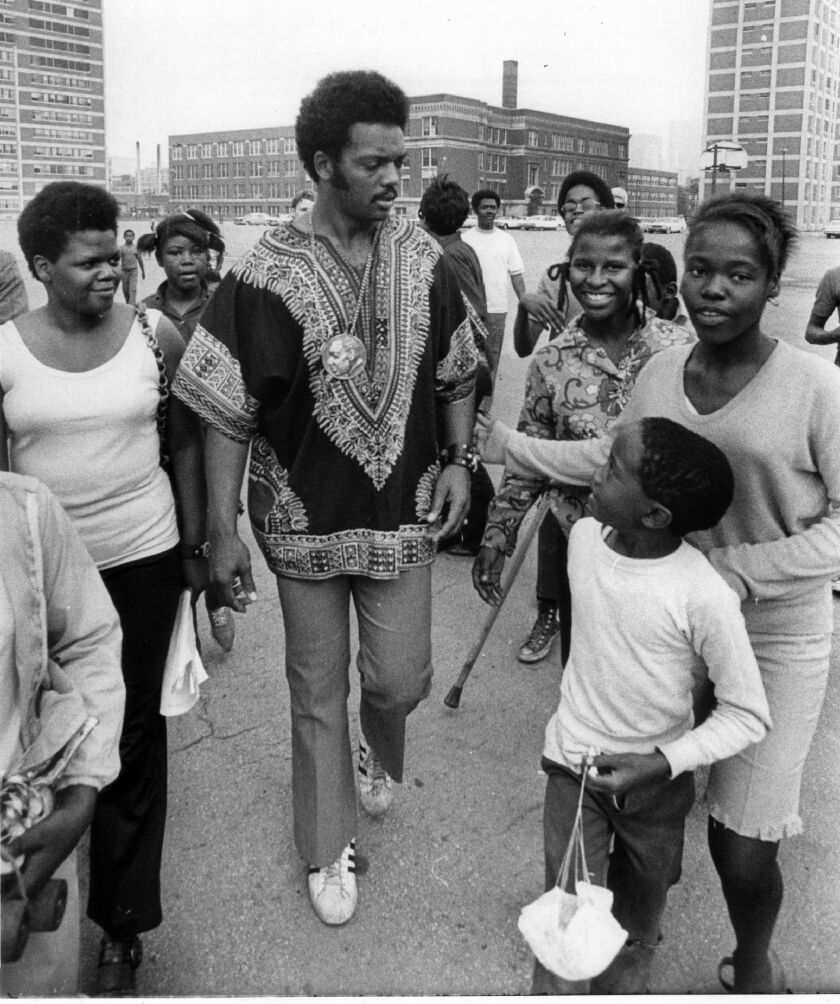
He was amazed that on Cottage Grove Avenue he could sit and eat at the lunch counter at the Walgreens, something he couldn’t do at home, where he attended the segregated Sterling High School. The 6-foot-2-inch student was a three-letter high school athlete — baseball, basketball and football.
In 1959 he went to the University of Illinois at Champaign-Urbana on an athletic scholarship. It was during a trip home to Greenville for his first Christmas break that Rev. Jackson was drawn, quite by accident, into the civil rights struggle.
He was supposed to write a speech — on patriotism, ironically — but the books he needed were not available at the McBee Avenue Colored Branch of the Greenville Public Library. The librarian there sent him with an explanatory note to the main, whites-only library downtown, naively phoning ahead, thinking to smooth the way. What the call did was make sure two police officers were waiting for him after he walked to the library. He tried to get the books he needed; the police threatened to arrest him if he didn’t leave without them.
The humiliation stung.
”I had to break off my Christmas vacation four days early to get back to Illinois to get that speech done,” Rev. Jackson told The New Yorker in 1992. “I remember riding that train alone back to Atlanta and to Nashville, and up [to] Chicago and on the bus back to Urbana, thinking the whole way, That library’s public. And when I get back home this summer it’s going to go public for real. I’m going to use that library.”
‘The Greenville Eight’
And so he did. On July 18, 1960 he returned with seven friends, went into the reading room and looked at books, refusing demands that they leave. The police came and arrested them for disorderly conduct, and they became “The Greenville Eight.”
The subsequent lawsuit led to a ruling that the libraries must be desegregated. Greenville instead shut down all their public libraries, blaming those who tried to use them.
“The efforts being made by a few Negroes to use the White library will now deprive all White and Negro citizens of the benefit of a library,” Greenville Mayor J. Kenneth Cass said in a statement.
Prejudice was not limited to the South. Disappointed with the racial isolation and slights he found in Illinois, Rev. Jackson transferred to North Carolina Agricultural & Technical College in Greensboro before his junior year. There, he met a freshman named Jackie Davis Brown.
”He looked at me and he said, ‘Hey girl, I’m going to marry you’,” she told Frontline. “Which totally offended me because at that time, I had no interest in being tied down with children and a family and a responsibility.”
But tied down she became. They married on New Year’s Eve, 1962.

Jackson graduated with a bachelor’s in sociology in 1964. In 1965, he and his wife and daughter Santina moved to the city, living near 68th and Cottage Grove, while he studied at the Chicago Theological Seminary.
Rev. Jackson was an excellent student who got a D in preaching, because he refused to write out his sermons ahead of time.
’’That’s Jesse. He’s a very brilliant guy. But undisciplined,’’ said the Rev. Victor Obenhaus, Jackson’s faculty adviser and a professor of Christian ethics. ‘’We have very rigid requirements. One has to do with articulating your philosophical and theological groundwork. Jesse couldn’t do that in a coherent fashion.’’
A desire to meet MLK
As with so many others, Jackson was energized by television coverage of the police attacks on civil rights marchers in Selma in March 1965. He urged his fellow students to put their abstract notions of faith into action and 30 joined him driving down to Alabama, where Jackson met King adviser Ralph Abernathy.
Rev. Jackson insisted he be given a job and an audience with King, and was granted the latter. He urged King to bring his work to Chicago, an uncommon local view, since the most influential Chicago Black ministers were in Mayor Richard J. Daley’s back pocket, and would hold a televised press conference, urging King to stay away.

In February 1966, Rev. Jackson started reaching out to local congregations for help starting what he called “a ministry of jobs.” By April, 400 ministers had signed on and Rev. Jackson expanded the Southern Christian Leadership Conference’s Operation Breadbasket to Chicago.
The first business approached, the Country Delight dairy, refused to cooperate. For a while. Three days after a boycott was announced, 44 new or upgraded jobs for Blacks were found at the dairy. Rev. Jackson began with dairies, he later explained, “because it is particularly vulnerable. Milk can’t stand around. It has to be sold, or the man suffers a loss.”
Jackson also became a voice on the Chicago political scene. In March 1966, when Daley allowed Prince Philip to address the City Council, Rev. Jackson wondered why the royal had been welcomed while King was turned away.
”Dr. King’s mission is more serious than Prince Philip’s,” Rev. Jackson said.
In August 1966, Rev. Jackson led a march against housing restrictions, guiding 300 supporters, outnumbered seven-to-one by a “jeering, missile-throwing” crowd of 2,000 whites carrying Confederate flags and signs reading, “Keep Out Black Trash,” while hurling bottles, rocks and cherry bombs. The march turned back after police threatened to arrest the protesters.
On April 4, 1968, King stepped out onto the second floor balcony at the Lorraine Motel in Memphis. Rev. Jackson was in the parking lot below.
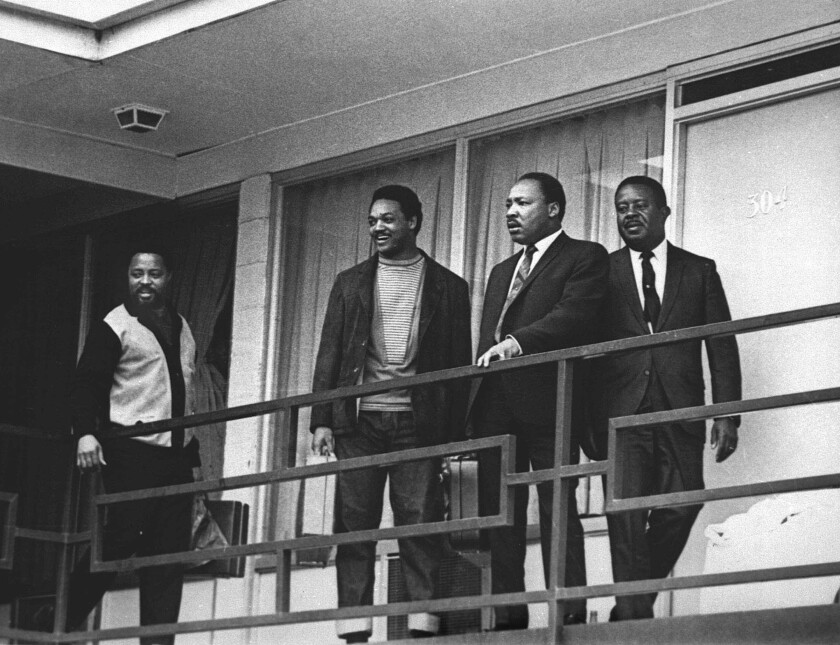
”Our leader!” he cried.
”Jesse!” King said. “I want you to come to dinner with me tonight!”
”Doc, Jesse took care of that before you did,” said Rev. Billy Kyles, a minister who had urged King to come to Memphis. “He got himself invited.”
Moments later a single shot cut down King. Rev. Jackson flew to Chicago, where he appeared on television wearing the same bloody tan turtleneck he had on the evening before, claiming he had cradled King’s head as he died.
”On my chest is the stain of blood from Dr. King’s head,” Rev. Jackson told the cameras.
The claim drew furious denunciation from King’s inner circle and caused bitterness that lasted for years.
“I look around and sure enough. … Jesse Jackson’s shirt was drenched in blood,” King confidante Hosea Williams later said. “And I realized the only way Jesse could’ve gotten that blood was stoop down on that floor of the Lorraine motel, and [he] raked that blood off that floor and put that blood on him.”
Jackson biographer Marshall Frady viewed the act in context of the tendency of followers of slain prophets to preserve the blood of their fallen martyrs, observing that, even if Williams were correct, the act amounts to “a kind of anointing with King’s very blood,” one proven prophetic in light of subsequent events.
”To a considerable degree,” Frady wrote, “in the national activation of the black voting rights won by King in Selma, in his perpetuation of King’s vision in the national life, in his ascent to become almost a totemic figure for America’s black community, Jackson has proved to be probably King’s single notably legatee.”
Rev. Jackson was ordained at Fellowship Missionary Baptist Church on June 30, 1968.
The origins of PUSH
Constantly clashing with the Student Nonviolent Coordinating Committee [SNCC] back in Atlanta, Rev. Jackson formed his own organization, originally called People United to Save Humanity but gradually morphing into the Rainbow PUSH Coalition.
Time magazine devoted a special issue to “Black America 1970” in April of that year. “Any one of a dozen such grass-roots leaders could be used to symbolize the ways in which black gains, however modest, are being achieved in communities,” Time wrote, before singling out the minister whose face was on the cover. “One who is more articulate and arresting than most is Rev. Jesse Jackson, an intense, passionate advocate of using black economic power.”
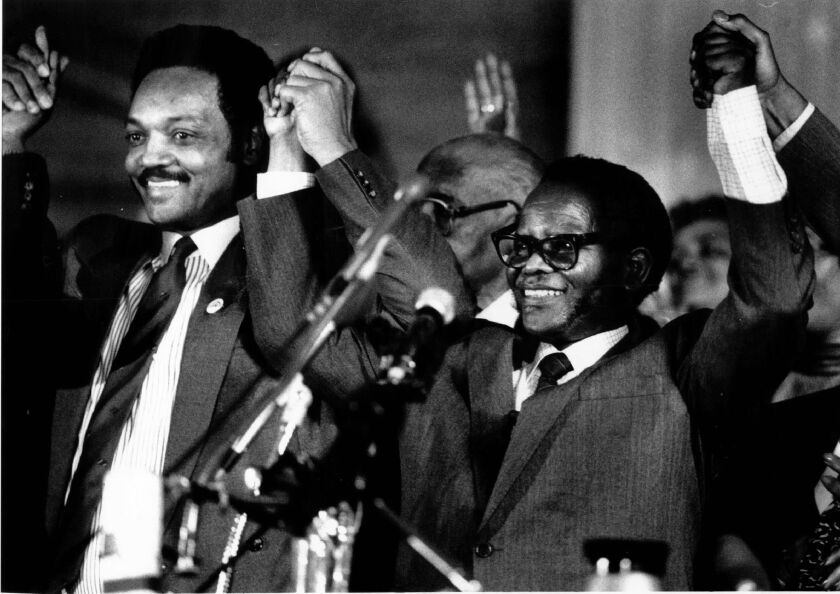
In the late 1970s, Jackson began to travel as an international mediator and advocate. In South Africa, he condemned apartheid as “ungodly,” denouncing its government as a “terroristic dictatorship” and “making more of a stir among both blacks and whites than any American political figure to come here in many years,” The Washington Post reported.
Rev. Jackson’s breakout year was 1983, when he crisscrossed the country, registering Black voters.
Shortly before the Democratic National Convention in July 1984, Jackson embarked on a tour of Central America. In Nicaragua, he condemned financing of anti-Sandinista insurgents by Ronald Reagan’s administration. In Cuba, he met with Fidel Castro, negotiated the release of 22 American prisoners and brought them back to the United States.
“I did it for him,” said Castro, insisting he had freed the prisoners ‘’as a result of Rev. Jackson’s visit.”
The first foray into politics
Jackson ran as a candidate himself in 1984, and did well in the Democratic primaries, garnering 21% of the vote. After Rev. Jackson was quoted in an interview by a friendly Black reporter calling Jews “Hymies” and New York “Hymie town,” his campaign became bogged down in controversy, particularly after Nation of Islam leader Louis Farrakhan, whose Fruit of Islam provided security to Rev. Jackson, threatened to kill the reporter and his wife, and Rev. Jackson was slow to repudiate Farrakhan’s words.
The rift with the Jewish community would take years to heal, and was widened by Rev. Jackson’s embrace of Yasser Arafat and the cause of Palestinian independence.
In 1988, Rev. Jackson ran again and did even better, earning 29% of the primary ballots — seven million votes.
Jackson moved from Chicago to Washington in 1989, where he ran for one of two shadow senator positions created by the District of Columbia Council to lobby for D.C. statehood inside Congress. He used that six-year term — which came with no salary, office or budget — to advance his Rainbow Coalition agenda.
Instead of pushing for a third presidential run in 1992, Jackson pulled back from politics, recasting himself as a TV commentator, appearing on CNN for eight years.
After Saddam Hussein invaded Kuwait and threatened to scatter Western hostages to sites that might be attacked by American air strikes, Rev. Jackson went to Baghdad and negotiated their release.
The moment reflects the duality of Rev. Jackson’s career — he traveled around the world to free hundreds of people who might otherwise have perished in the coming war, yet returned home to face indifference and questions as to whether he should have gone at all.

Rev. Jackson remained in the thick of politics in the 1990s as President Bill Clinton took office and Jesse Jackson Jr., his second-oldest child, was elected to fill a seat vacated by U.S. Rep. Mel Reynolds, who resigned in 1995 after a jury convicted him of sexual assault charges.
After an initially rocky relationship, Rev. Jackson became an adviser and friend to Clinton, counseling him during the hearings leading to the president’s impeachment by the House and subsequent acquittal by the Senate.
In 1997 Jackson accepted a Clinton appointment as special envoy of the president and secretary of state ”for the promotion of democracy in Africa.” In that role, he visited troubled republics from Nigeria to the Congo, met with leaders including Nelson Mandela of South Africa, Daniel T. Arap Moi of Kenya and Frederick J.T. Chiluba of Zambia and engaged in government-sanctioned negotiations. In war-torn Sierra Leone on May 24, 1999, he brokered a cease-fire between President Tejan Kabbah, and rebel leader Foday Sankoh.
In 2000 he received the nation’s highest civilian honor, the Presidential Medal of Freedom.
Rev. Jackson acknowledged in January 2001 that he’d had an extramarital affair after the National Enquirer learned of Jackson’s relationship with Rainbow PUSH employee Karin Stanford. The couple had a daughter in May 1999.
‘’I fully accept responsibility, and I am truly sorry for my actions,” Rev. Jackson said. “As her mother does, I love this child very much and have assumed responsibility for her emotional and financial support since she was born. I was born of these circumstances, and I know the importance of growing up in a nurturing, supportive and protected environment.”
Obama and Jackson
Rev. Jackson kept a low profile after the scandal, but the rise of Barack Obama prompted him to seek credit for the changes he helped bring. It was hard for Jackson to see the younger man strive for and achieve the true political power — insider power — that had always eluded him.
Rev. Jackson made the rounds of newspaper editorial offices, quietly lobbying for recognition of his role in the ascent of Obama, for laying the groundwork. He felt he deserved some of the credit — but in unguarded moments was less diplomatic, sometimes saying Obama was too white, or talked down to Black people, once muttering “I want to cut his nuts out” into an open Fox News microphone.
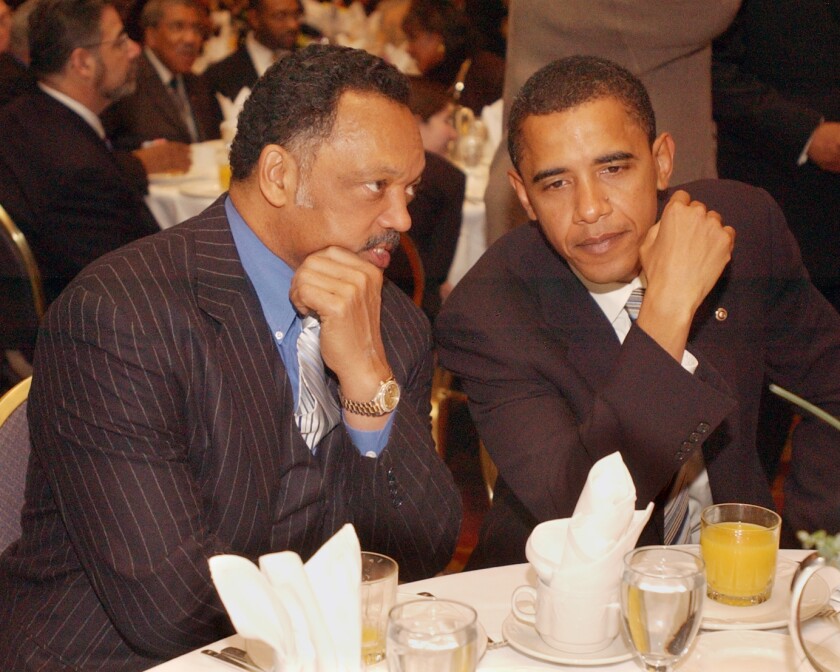
Obama diplomatically ignored Rev. Jackson, who apologized, but whose antipathy remained.
“He ended up fighting the people he helped make way for,” Rev. Al Sharpton said of Jackson. It didn’t help that Jesse Jackson Jr.’s political and personal life fell apart just as Obama’s was peaking, and Jackson’s namesake, who had larger ambitions himself, ended up disgraced and in prison.
Plaudits poured out in July 2023 when Jackson stepped down as head of the Rainbow PUSH Coalition.
“Through decades of service, he has led the Rainbow PUSH Coalition at the forefront of the struggle for civil rights and social justice,” said Mayor Brandon Johnson. “His faith, his perseverance, his love, and his relentless dedication to people inspire all of us to keep pushing for a better tomorrow.”
Asked by the Washington Post in 1983 how he wanted to be remembered, Rev. Jackson replied: “I did the best I could with what I had, and I gave my best against the odds.”
Survivors include his wife Jacqueline and their five children: Santita, Jesse Jr., Jonathan, Yusef and Jackie. He also had a sixth child, Ashley, in 1999 with Karin Stanford.
Contributing: Maudlyne Ihejirika.
Top Feeds
via Chicago Sun-Times: Chicago news, politics, sports and more https://ift.tt/ADsiWOK
February 17, 2026 at 05:32AM
 Illinois Delivered