
In the late 1970s, after building a small airport hotel into one of the biggest names in hospitality, the Pritzkers of Chicago joined forces with an ambitious young developer to convert an unfashionable hotel on New York’s 42nd Street into a sparkling Grand Hyatt. The building would have five restaurants, a signature atrium, and even—if the city would allow it—a casino. The project was a success, but the relationship went bust. The developer accused the family of “fraud, extortion, and money laundering” and sued them for $500 million (before eventually settling). The Pritzkers accused Donald Trump of simply being himself.
“If you want to see what kind of partner Mr. Trump is,” said Jay Pritzker, the hotel chain’s co-founder, “read his book.” If you want to understand the Pritzkers, you should start by reading theirs.
The book that Jay’s nephew JB says changed his life is called Three Score After Ten. It was written by his great-grandfather, Nicholas Pritzker; privately printed in 1941; and distributed to his descendants as they came of age. The two-term Democratic governor of Illinois, whose father, Donald Pritzker, died of a heart attack when JB was 7, received the first of his three copies at his bar mitzvah from his grandfather, AN. He estimates he has “read it at least five or seven times.”
Three Score is a rags-to-riches memoir bookended by authoritarianism. While Nicholas is the narrator, the family’s destiny is set by his brother, Abram, a “high tempered” student who is arrested in 1880 by the tsarist police and charged with treason for distributing “uncensored printed pamphlets” in Kyiv. After he’s sentenced to exile in Siberia, his mother gets him released—but pogroms sweep the city, and the family has to flee. Abram, traveling without a passport, escapes with the help of smugglers, but loses his possessions to “the border patrol.” They finally make it to the Midwest, with the help of benevolent American Jews.
Nicholas arrives with almost nothing but eventually passes the bar exam and starts the firm that will bind together a $15 billion network of companies with holdings in everything from hotels to furniture and snuff tobacco. But Nicholas rejects the myth of rugged individualism. He is lifted at every step by helping hands and tells his heirs they have a duty to support “poverty-stricken immigrants.”
Three Score is a hard book to find. JB once said it is “not on the bookshelves anywhere.” But a family that has donated dinosaur bones, surrealist art, and hundreds of millions of dollars to institutions around the country can’t be expected to keep every copy for itself. When I mentioned, during an interview in December, that I had recently discovered one at the Yale Center for British Art, the governor raised his eyebrows with a look of genuine surprise.
Pritzker, who is 61 with a nose tackle’s frame and patrician streaks of gray flaring out from his temples, told me he was struck by his great-grandfather’s humility. Nicholas’ story reminded his heirs that they came “from a long line of people who have had many of the same struggles that others have around us.”
But there was a more immediate salience to a story of refugees and their helpers. Ukrainian Jews, like “so many groups” over history, he said, had been subjected to “demonic kind of attacks” by people who perceived them as others.
“That’s something that drives me every day—to think about upon who else is this kind of hatred and bigotry being visited,” he said. “It is my obligation, as someone whose family has survived that, to pay it forward.”

We were sitting at a small table in the sunlit playroom of a brick church in the Chicago neighborhood of Little Village. Red and blue blocks were stacked beneath the window. Above us was a passage from Proverbs: “Train up a child in the way he should go; Even when he is old he shall not depart from it.”
Pritzker had come to the West Side on a snow-covered Tuesday to sign into law new protections against what he called the “depravity” of Trump’s mass deportation regime. For months, masked federal agents had swarmed Latino neighborhoods like this one, snatching residents off the streets and terrorizing citizens and noncitizens. They attacked protesters, ransacked homes, sprayed tear gas near schools, rappelled into an apartment building, and shot a 30-year-old woman five times for the crime of honking her horn. If Trump 2.0 has often felt like a protracted siege on American democracy, “Operation Midway Blitz” was its forward line, in which heavily armed men, coked up on memes, tested the defenses of civil society.
Illinois responded with defiance. Pritzker fought Trump’s plan to turn Chicago into a military “training ground” and hailed the residents who organized their communities and followed agents with whistles and smartphones. Speaking in the auditorium of the church a few minutes before we met, Pritzker announced that day cares, schools, hospitals, and courts would be required to safeguard personal information and develop plans for dealing with immigration raids, and residents would be empowered to sue federal agents.
“We’re sending a message to Donald Trump, to Kristi Noem, to Gregory Bovino, and anyone else seeking to terrorize our people,” he said. “Your divisiveness and your brutality are not welcome here.”
In a year when elite institutions teetered and caved, and some Democrats seemed more interested in fighting the last war than defending their backyards, Pritzker seized the floor as one of the president’s fiercest antagonists—a blue-state governor who stood up to the regime and demanded justice for its victims. “It’s time to fight everywhere, and all at once,” he declared at a dinner in New Hampshire last spring, while slamming “do-nothing Democrats” in DC. In October, he told a group of teachers that “Donald Trump and his cronies can fuck all the way off.”
In some respects, Pritzker makes an awkward champion for a Democratic Party looking for a new direction. He is a billionaire in an electorate raging against oligarchy and a former AIPAC supporter at a time when support for Israel is plummeting. (A spokesperson for the governor said Pritzker had not donated to the group in “nearly a decade” and “believes the organization has abandoned its bipartisan principles and become a pro-Trump organization.”)
The pugilist who now castigates “hedge fund managers and tech bros” was a Facebook-investing venture capitalist. If you’re looking ahead to 2028—which, New Hampshire dinner notwithstanding, aides insist he is not—it is possible to imagine a future campaign crashing against the reefs of his family’s offshore trusts.
But it is impossible to separate Pritzker’s contemptuous response to Trump from the path he took to office. The desire to wield his advantages without being reduced to a caricature of them has been the central tension of his career. The family name opened doors and helped him weather setbacks that might have sunk a poorer candidate. It allowed him to spend more than $300 million on political campaigns since Trump’s first election and acquire a unique duality of influence—part officeholder, part megadonor. His background—and how he makes sense of it—also helps explain why, at a moment of upper-class capitulation, he resisted so viscerally when so many others sued for peace. Three Score is a story, in part, about what is owed. Pritzker would probably never have made it this far if he wasn’t a Pritzker. But if it weren’t for his family, he might never have wanted to.
The governor has said that he grew up in a “small-business household,” and although the business was literally Hyatt, there is nonetheless an element of truth. Donald and his wife, Sue, raised their three kids in a modernist compound in the upscale San Francisco Bay Area suburb of Atherton, but Jay Robert (who has always gone by JB) and his older siblings, Tony and Penny, learned the hospitality business at the chain’s outpost nearby—they hauled dirty sheets to the laundry and managed the front desk. In their free time, the family dabbled in politics. Sue marched for abortion rights and recruited her kids to stuff envelopes for Democratic campaigns. Donald was one of Ed Muskie’s finance chairs. A scene in The Candidate was filmed in his office; the kids’ photos are on the wall.
After Donald’s death in 1972, Sue spiraled. JB has talked about finding his mother bleeding in the bathroom and of staying up late to make sure she put out her cigarettes. Penny, the oldest, planned her kid brother’s bar mitzvah with Tony. When Penny went to Harvard, JB enrolled at nearby Milton Academy. On weekends, she would take him out for lunch.
Phil Robertson, who roomed with Pritzker and hosted him for family dinners during holidays, described the future governor as a fiercely loyal friend who flourished in the boarding school milieu. He was a “super competitive backgammon player,” Robertson recalled, and a techie in the theater club who could “talk to anybody about everything.” The two friends converted half of their two-bedroom suite into a game room for the rest of the floor. Ryck Birch, who was a grade above him, described Pritzker as “a roly-poly little kid,” like “an affable bear cub.”
A parting gift to campus captured the ways in which Pritzker fit in and stood apart. A group of students started an alternative newspaper, to rival what Birch called the “tepid, vanilla, pablum” of the school-approved rag. Pritzker chipped in, not by writing columns, but by financing the venture—even after he’d gone off to college.
But back in California, Sue’s struggles worsened. A few weeks before his graduation, and nearly 10 years to the day after Donald’s sudden death, she jumped out of the passenger seat of a tow truck and was killed instantly. Penny called her little brother with the news.
“My mother was my hero,” he said in a 2022 campaign ad. “We knew that whatever she was going through, and whatever we were experiencing as a result, had nothing to do with whether she loved us or not.”
Pritzker enrolled at Georgetown and took a part-time job in the office of Democratic Rep. Tom Lantos of California, but he found both experiences wanting. In an unpublished interview he conducted with the biographers of his mentor Terry Sanford, which I found in the senator’s papers at Duke University, Pritzker elaborated on what went wrong. He’d taken the job “bright-eyed and bushy-tailed and young and idealistic,” but found instead a “nightmare.”
One encounter encapsulated the experience. Pritzker told Lantos he wanted to spend the summer working on his reelection campaign.
“You know,” the congressman replied, “it would be a lot easier for me to give you a job on my campaign if your family would give money to it.”
Pritzker quit on the spot. He eventually left Georgetown, too. Now at Duke, missing his family and “disgusted with politics,” he described himself as “a lost puppy.” Then he got a call about the man students called Uncle Terry.
If Three Score taught him what it meant to be a Pritzker, it was Sanford, he wrote later, in a personal statement that accompanied his law school application, who defined “the moral parameters within which I matured in politics.”
A war hero who became one of the first Southern governors to push for desegregation, Sanford was the longtime president of Duke, where he’d eliminated a cap on Jewish students and sided with Vietnam War protesters. When he decided to run for the Senate in 1986, aides hoped to freshen his image by surrounding him with students. Pritzker, who was introduced to his college president “almost immediately” after arriving on campus, was recruited for the team.
For someone who loathed being viewed as a bank account, it was a romantic reintroduction to politics. Pritzker learned the ropes of advance work from a guy who’d had the same job with JFK and adapted to the local customs. At the campaign headquarters, in an old tobacco warehouse, a veteran operative told Pritzker to stop answering the phones because his accent (or lack thereof) was off-putting to locals. Out in the field, he dropped his last name and became simply “JB from Durham.”
To some colleagues, the name meant nothing. David Poisson, Sanford’s campaign field director and later a Senate staffer, told me he and Pritzker would often grab Chinese food after a long day at the office. For weeks, Poisson picked up the check.
“Sanford said to me one day, ‘What did you do last night?’ And I said, ‘Well, I went out to dinner with JB,’” Poisson recalled.
“Who paid?” Sanford asked.
“I did.”
“What do you mean you did?”
“Of course I paid,” Poisson said. “He’s a college student.”
“He could buy you eight ways to Sunday,” Sanford said, filling him in.
Pritzker followed the victorious Sanford to DC after graduation, where he put in 12-hour days and worked on Latin American affairs. He was just another eager twentysomething in a town that runs on them. (Still, his background afforded a lifestyle that might have eluded other grunts: Pritzker—who reported $1.4 million in gambling winnings in 2024—once spent the first night of a trip with Sanford to Costa Rica playing blackjack at a casino with the chairman of the Securities and Exchange Commission.) About six months into his tenure, Pritzker popped into Sanford’s office for advice. He wanted to run for office—what should he do?
First off, the senator said, he needed a different boss. Pritzker could never get elected statewide in North Carolina and needed to be strategic. Sanford offered a life plan: “Figure out where it is you are going to run from, go back there, and make a life there…Go to law school where you want to run, and get to know the people there.”
Not long after, Pritzker stopped by Poisson’s desk to tell him he’d taken a job with Sen. Alan Dixon of Illinois.
“It’s time to go home,” Pritzker said.

What Sanford had offered Pritzker, beyond an entry-level job, was a style of leadership that contrasted sharply with other politicians. The senator could seem like a character out of The West Wing—a college president with a Purple Heart who served squirrel at dinners and offered fatherly advice over scotch. But above all, Pritzker told Sanford’s biographers, there was a boldness about the senator that almost made him tear up.
“Sanford always had either the confidence that he would get sent back [to Congress] because people would trust his judgment, or the ability to say that this is just the right thing to do,” he said.
Dixon, by contrast, was someone who would constantly “stick his finger up in the wind.” But he served a purpose, too. Pritzker made connections in Illinois, studied law at Northwestern, and began to carve out a lane for himself as a Democratic fundraiser and investment banker. Before leaving Washington, on a blind date, he met Mary Kathryn Muenster—a staffer for Sen. Tom Daschle—and they married in 1993. By the time a House seat opened up in 1998 in Chicago and its northern suburbs, Pritzker had been preparing to run for years.
He got crushed.
The simple explanation is that Jan Schakowsky was such a good candidate that she still has the job. But Pritzker was a flawed one. While mailers touted his Washington experience, there was something off about a wealthy scion telling people they should vote for him because he’d once been a legislative aide. JB’s uncles (who referred to him as “the pinko in the family”) were active behind the scenes, and support trickled in from Barbara Boxer, for whom JB fundraised; Sid Luckman, with whom AN once tried to buy the Bears; and a North Side political boss whose son-in-law, Rod Blagojevich, Pritzker had helped to elect.
“I think JB was conflicted in trying to find what his voice was—he didn’t want to be viewed as kind of a dilettante,” said Mark Poole, a friend from the Sanford days who managed his congressional campaign. “There was lots of conversations of, ‘I can’t just throw money at this, we don’t like the optics of that.’”On the other hand, Pritzker threw a lot of money around, while boasting that he alone could not be bought. At one point, he was even paying to hide campaign messages in fortune cookies. In the final weeks of the race, Pritzker spent half a million dollars of his own money on TV ads, one of which featured the candidate in a Bears jersey holding a football out of the reach of a group of kids.
“People called it ‘the Fridge ad,’” one Chicago Democrat said—a reference to the Bears lineman William “the Refrigerator” Perry.
Despite his best efforts to present himself as a “bold” and courageous thinker in Sanford’s mold, Pritzker complained afterward that “a lot of people looked at me and just saw dollar signs.” It was hard not to. He had climbed the ladder without dwelling on how the ladder got there—perhaps that’s why Lantos’ words had stung.
“People like me,” he once said, “spend our whole lives trying to run away from the word ‘heir.’”
Pritzker waited nearly two decades to run again. In the interregnum, he set out to make a name for himself. Despite Trump’s assertion that Pritzker’s family “threw him out of the business,” JB was never centrally involved. Around 2000, after Uncle Jay passed away and Uncle Bob ceded control of the family companies to Penny and two cousins, another group of cousins, including JB, pushed to divide the fortune. After some contentious wrangling, they reached a deal in which AN Pritzker’s 10 grandkids (including JB) would get about $1.4 billion each. The problem was that AN had 12 grandkids. Bob’s children from an acrimonious second marriage were treated, because of the age gap, as AN’s great-grandchildren. When they found out, they sued for billions.
Pritzker v. Pritzker offered a rare look inside a family that had, per AN, steered clear of “public business.” Plaintiffs and defendants—some represented by future Supreme Court Justice Neil Gorsuch—sparred over not just the value of their inheritance, but its purpose. If Nicholas’ memoir instilled a noblesse oblige, the family foundation and network of trusts provided the architecture.
AN “believed that it is an integral part of the Pritzker family way of life that they constantly increase the scope of their charitable contributions,” one judge wrote, in an opinion from an earlier case that was entered into the record. But AN also believed that charity had tangible benefits—big donations, like the construction of a hospital, helped the Pritzkers close big deals.
The court filings also highlighted the lengths to which the “tax conscious” AN went to shield the family money. When he died in 1986, his estate claimed that the head of one of America’s richest companies had been worth just $25,000. The IRS sued for $53 million but eventually settled for $9.5 million plus interest. Where did it all go? In court filings, the excluded grandkids—who eventually settled for $500 million apiece—detailed a maze of trusts in the Bahamas. According to an estimate by Forbes, the family held $3 billion offshore.
A spokesperson stated that Pritzker (who put his assets into a blind trust after being elected) “has never taken a disbursement from any offshore trust and has directed that any disbursements be given to charity.” That was also the governor’s line in a 2018 primary against a Kennedy (RFK Jr.’s brother Chris, who also had an offshore account) and in a general election against Gov. Bruce Rauner (a private equity mogul who also had offshore accounts). But to fully accept the premise, you’d have to disregard AN’s insight about philanthropy: It’s not just the recipients who gain from it.
In the years that followed his first defeat, Pritzker built a VC firm with his brother and wielded the sort of influence he might have found wanting in Washington. He joined the boards of Northwestern and Duke and, with his wife, sank time and money into a Sanford-style big idea—working with a Nobel laureate and Goldman Sachs to push investments in early childhood education. He organized a charity casino night at a private club that brought in everyone from the hedge funder Ken Griffin to the world poker champion Phil Hellmuth. Chicago magazine dubbed him “the other mayor of Chicago.” (Pritzker “has always believed philanthropy means more than writing checks,” the spokesperson said, and “has spent a significant amount of time and energy invested in improving the lives of others and holding leadership positions that bring people together to get big things done.”)
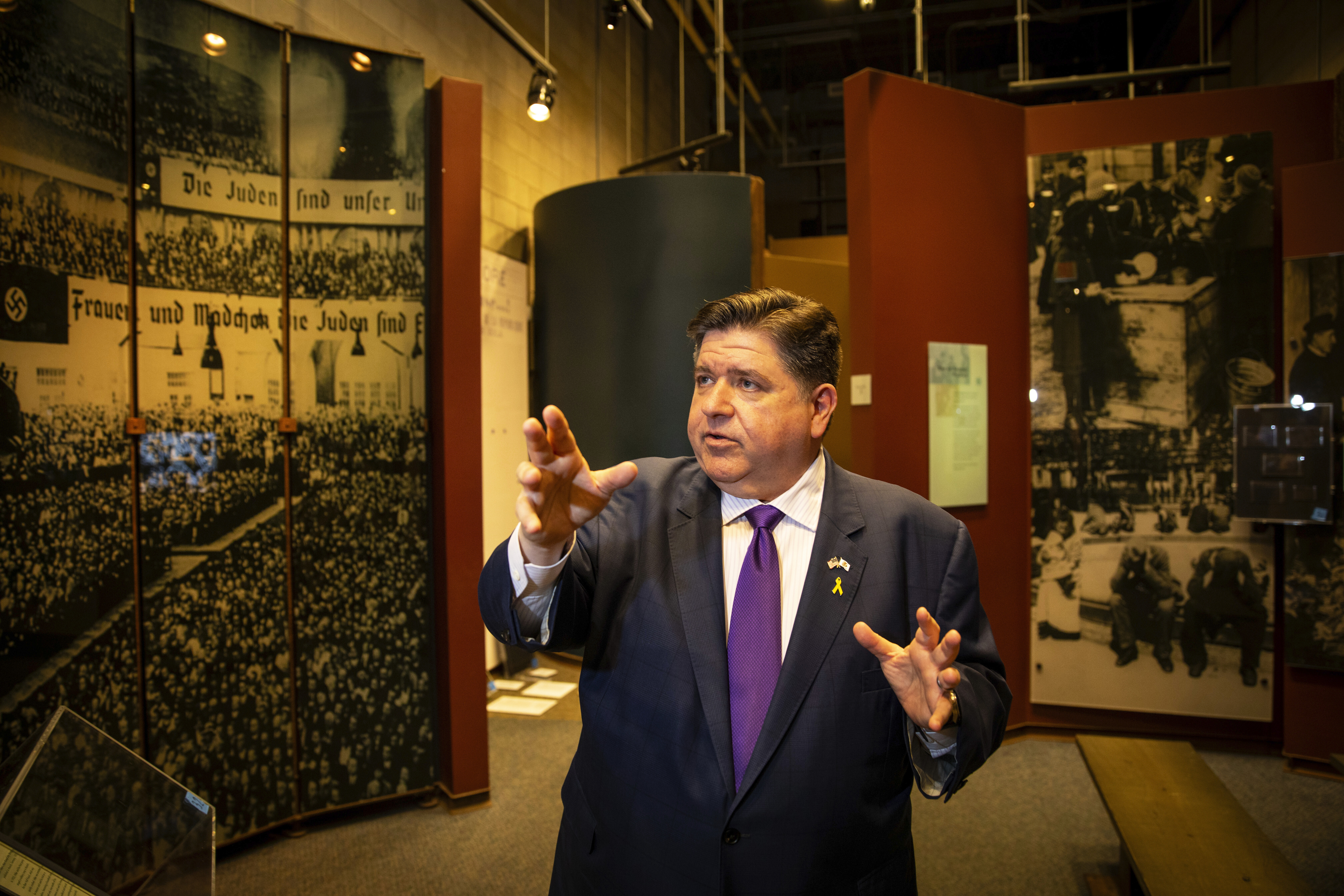
One project in particular has served as a bridge between his career in politics and his career outside of it. In 1999, a Holocaust survivor named Sam Harris approached him about opening a new museum in Skokie, the Chicago suburb famous for being the site of a planned Nazi demonstration in 1977. Pritzker, after some convincing, came on board.
Harris, now 90, describes himself as “almost like his uncle,” and Pritzker, for his part, seems to reciprocate the familial bond. They remain in regular touch. It almost sounds too obvious to call the decadelong process of building a Holocaust museum a formative moment for an opponent of authoritarianism, but Pritzker has made the connection explicit, in public and behind closed doors. One Pritzker insider recalled a meeting early last year between the governor and a visiting European ambassador. The diplomat brought up the governor’s combative posture toward the president and asked Pritzker if it was wise to box himself in.
Pritzker replied that he had no choice. At the Holocaust museum, he explained, the exhibits classified how people responded to authoritarianism in three ways—collaborators, bystanders, and upstanders.
“I have to be an upstander,” he said.
When Pritzker ran for office again, in 2018, opponents once more accused him of attempting to buy the race (he spent more than $170 million) and flogged a Chicago Tribune investigation—based on records from the Paradise Papers—into his use of offshore companies for, among other things, a duck-boat tourism venture. Republicans made light of an incident in which the Pritzkers had removed all the toilets from the empty mansion they owned next to their actual mansion, and then had the building reassessed as uninhabitable—saving big on their taxes. (Pritzker said he “followed the rules,” but paid back $330,000.) It was all a bit Mitt Romney.
But Pritzker could (and did) talk about building a Holocaust museum, funding early childhood education initiatives, and launching a tech incubator that powered hundreds of local startups.
In the first campaign, “there just wasn’t much [of a] there there,” said Peter Giangreco, a Chicago political consultant who worked for Schakowsky in that race. “The difference between him running for Congress in ’98 and running for governor in 2018 was there’s just a tremendous body of work.”
Pritzker’s most serious hurdle involved his relationship with Blagojevich. After the 2008 election, as the governor was attempting to sell Barack Obama’s vacated Senate seat, Pritzker was recorded on a wiretap discussing the viability of various Black Democrats (he describes one potential pick as the “least offensive”) while pitching himself for state treasurer. The transcripts, which the Tribune published in 2018, offered an unflattering picture of a would-be politico bantering with a crook in search of patronage. (Pritzker has apologized for his comments about the Black politicians and said he was not his “best self.”)
The election, though, was ultimately a referendum on Rauner, who failed to pass a budget for two years in an impasse with Democratic legislators. The state owed $16 billion at one point, and basic services were being cut off. Pritzker has analogized the budget crisis to DOGE; his tenure has amounted to a cleanup job.
By recent metrics, Pritzker has been a clear success. He has not gone to prison, and the state’s finances stabilized, though Illinois is again in a budget crunch thanks in part to Trump’s cuts. With Democratic supermajorities in the legislature, he raised the minimum wage to $15, slashed medical debt, legalized marijuana, expanded abortion rights, capped the price of insulin, and banned right-to-work regulations.
His tenure has been defined both by an ambitious agenda and by the huge sums of money he’s spent to get what he wants. In one of his first big fights, he personally spent $56.5 million to sell a ballot initiative to raise taxes on millionaires. Griffin, the Trump-backing hedge funder, spent $54 million and defeated it.
But the cash kept coming. Ahead of his reelection in 2022, Pritzker spent $24 million to elevate Darren Bailey, a conservative he considered more beatable, over a moderate Republican backed by $50 million from Griffin. (Pritzker spent another $152 million in the general election anyway.) That year, he was also the first- and second-biggest donor to two state Supreme Court justices—a feat he achieved by donating half a million apiece from his campaign account and a personal trust, circumventing a law he had signed capping “individual” donations.
All of this spending, and the policy wins that have come with it, has produced an unusual cult following. Pritzker has inspired a tongue-in-cheek X account called Socialists For Pritzker. Progressives on Bluesky sometimes call him “the Great Khan.” His image has been softened by the fact that he does not come off as the sort of billionaire who uses peasants as chess pawns—he is a big guy, you may have noticed, and a nerd. When I asked a former aide what Pritzker does for fun, she replied, very specifically, “Liberty puzzles”—referring to the purveyor of high-end wooden jigsaws. In Springfield, he has hosted bipartisan game nights for legislators.
“I mean, JB is fundamentally a warm guy. He is not a transactional, sort of brutal kind of personality,” said Howard Tullman, who worked with Pritzker on the tech incubator, when I asked how he compared with another Chicago Democrat. “And Rahm is Rahm.”
At times in Pritzker’s career, his willingness to wield his fortune against his political opponents has felt parodic—like, well, a grown adult holding a football out of reach of a bunch of kids. But in 2025, the dynamics had flipped: He was not the most powerful billionaire in American politics—he was that billionaire’s foil.
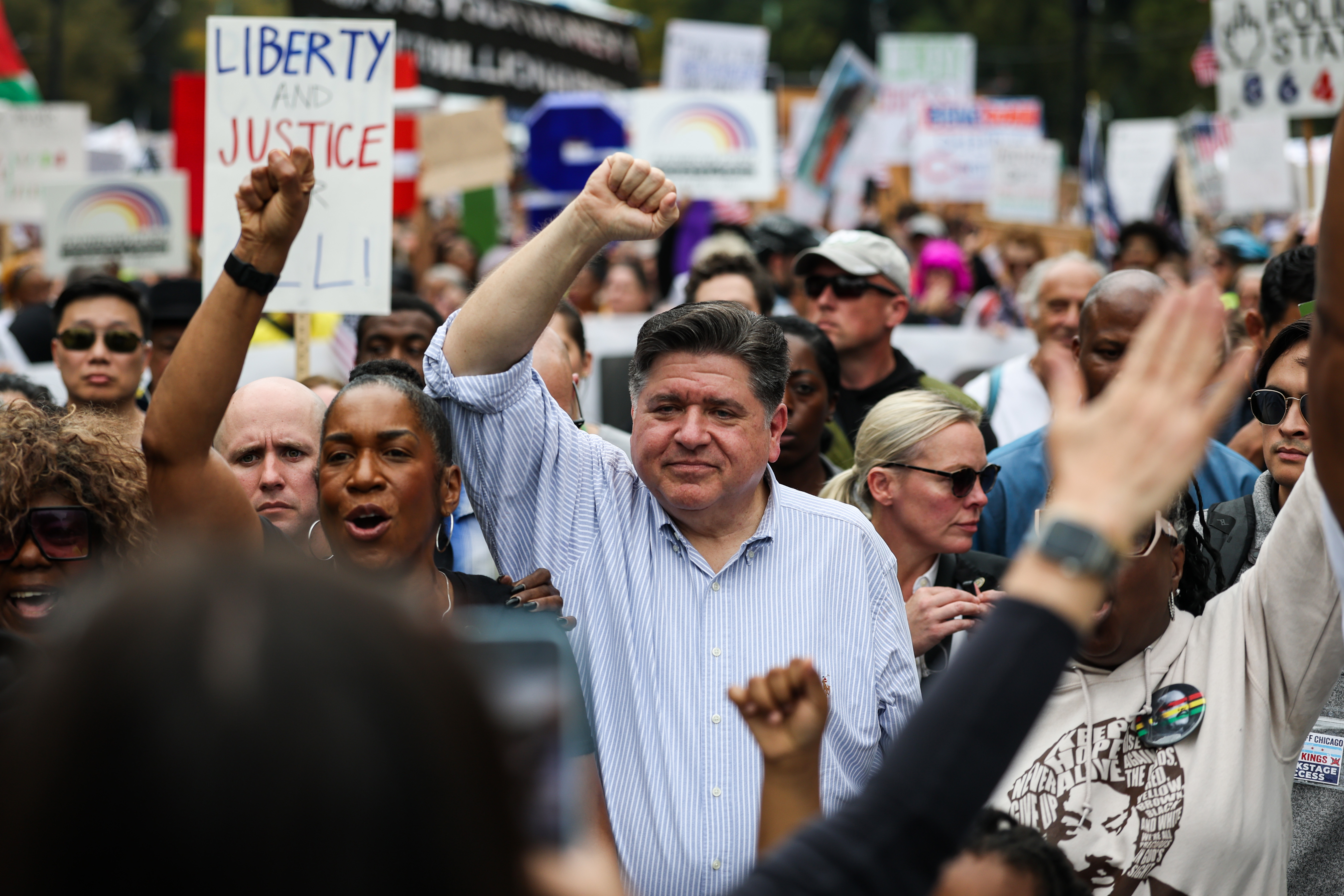
The speech in New Hampshire set the tone for the year that followed. He called for mass protests and urged Democrats to be “contemptuous” of the administration, whose portraits would be relegated “to the museum halls reserved for tyrants and traitors.”
When Trump announced that Chicago would “find out why it’s called the Department of WAR,” Illinois led the successful court battle to stop the National Guard deployment. When Trump threatened his arrest, Pritzker told him to bring it on. He asked residents to “film everything you see” in order to assist the state’s legal fights and launched a commission to collect evidence of Immigration and Customs Enforcement and Border Patrol abuses for future “corrective action and remediation.” Noem even blamed him for her struggle to find a public bathroom.
When we spoke, Pritzker expressed the hope that his community’s response to Operation Midway Blitz had been an inflection point.
“People who’ve never been activated before in their lives went and bought whistles,” he said, with a look of amazement. The “rapid responders” represented the sort of mass refusal to comply that “stops authoritarians, if you do it early enough.”
That was the sort of resolve he had come to Little Village to honor and reinforce. It was only part of the story, though. While ordinary people resisted, big law firms, universities, and tech companies had accommodated Trump’s demands. (One notable exception: Harvard, where Penny Pritzker leads the governing board.) This was what had made Pritzker’s defiance so significant—he was weaponizing his stature, instead of retreating behind it. When I noted the acquiescence to Trump among the sorts of people with whom he had more than passing familiarity, Pritzker, to my surprise, bristled.
“You’re suggesting that if you have money, that somehow that makes you evil, you know, that—I mean, that’s the suggestion behind your question,” he said, with a sort of incredulous laugh.
“That somehow having resources or being successful in business necessarily means that you have no values, or that you would work against the majority or against individual rights. And I think that’s just false. I don’t think it’s about how much money you have—I think it’s about what your personal values are, it’s about how you were raised, it’s about what you believe in and fight for, and what you’ve demonstrated during your life that you’ll fight for.”
It was not really a response to anything I’d asked, though it was clarifying to hear him assert himself in such a manner: Meme accounts aside, this might be the essence of his approach to service. He is not a class traitor—just a billionaire with a moral code locked in a struggle against a billionaire without one.
But I did want to know what he thinks about those of his station who have folded. After reassuring him that I did not believe all wealthy people lack morals, he offered a more analytical take.
“It may seem in the moment as if protecting that individual institution from that immediate threat is what your obligation is,” he said. “Maybe it seems like paying off the extortion being brought on them by Donald Trump is the right thing—in the long run, you may be paying $75 million to the federal government to get $700 million of research grants restored.”
They were making, in that sense, “an easy, transactional kind of decision” that wasn’t necessarily immoral, but lacked a wider perspective.
“I have talked to leaders of law firms, some of whom have capitulated, and I have said to them, either prior or after they’ve capitulated, that the context is that democracy is being sucked away from us—that each decision that gets made by each law firm individually seems like it’s about only their clients and their business and their lawyers, but actually, collectively, when they make that decision, it makes it easier for the next one to make the decision,” he said.
In Germany, in Chile, in Cambodia, the story had been the same, he continued. “Each time someone with a powerful position who might have personally good values makes a decision to capitulate, you’re accelerating the decline of society, the decline of the rights of people,” he said.
Pritzker, who is on the ballot this year in a likely rematch with Bailey (the governor has already spent $25.5 million), believes that if Democrats don’t win big in 2026, there might not be an election in 2028. “We’ve seen it fall before elsewhere—it could fall here in the United States just as easily.”
The Democratic Party is filled with ambitious politicians who raised hell and money before Trump’s second election, only to lose their sense of urgency after he won. As he sat in the empty playroom, Pritzker did not talk about authoritarianism like someone who was trying to fundraise (obviously) or get attention. He talked about authoritarianism like someone who is haunted by its ghosts.
One scene in Three Score stuck with me after I finished. Later in his life, Nicholas returned to Kyiv with his grandson Jay, and they passed through Berlin on the way back. It was just after the Night of the Long Knives, when Hitler violently purged rivals and consolidated his power. They have told each other they will not salute, but when diners in their restaurant rise to praise Hitler, the patriarch pauses.
“Grandpa, are we cowards?” Jay asks.
Of course not, Nicholas responds.
“Then we do not rise nor salute,” Jay tells him.
There are lessons in a book like this that you don’t need five or seven readings to pick up on. This is a family with a story. It is a family with ambition. It is not a family of cowards. To a teenager who had lost his father, the book was a gift that taught him what it meant to be a Pritzker. And although no one would have thought to say so then, you can’t help but think that it sounds a lot different from being a Trump.
Additional reporting by Jothi Gupta
via Mother Jones https://ift.tt/lQcNvHj
February 9, 2026 at 06:36AM
 Illinois Delivered