
More than half of Illinois counties will see just 1 percent of residents pay more
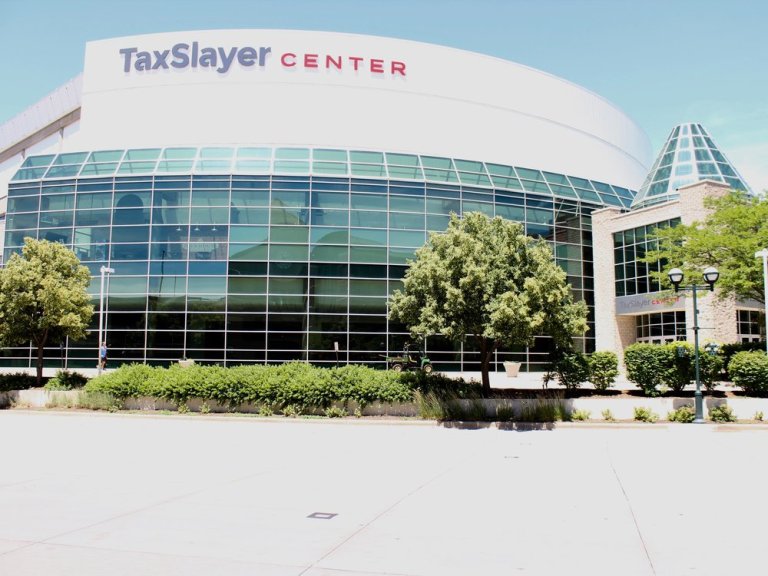
The TaxSlayer Center is located in Moline in Rock Island County, where 99.1 of taxpayers are projected to pay less under Gov. Pritzker’s “fair tax.” (One Illinois/Ted Cox)
By Ted Cox
Rural and downstate counties will enjoy the greatest benefits from Gov. Pritzker’s “fair tax” plan, according to data released Thursday by the Governor’s Office.
While Pritzker has maintained that 97 percent of Illinoisans will pay the same or a lower income tax under his proposal to adopt a progressive tax, his office said Thursday that more than half of all Illinois counties will see just 1 percent of residents pay more to the state.
Typical was Rock Island County, including the Quad Cities, but also farms inland from the Mississippi River. According to the Governor’s Office, 99.1 percent of county residents will pay the same or less, while just 0.1 percent of residents pay the top rate of 7.95 percent set for million-dollar earners.
Kankakee County will also see 99.1 percent of residents pay the same or less, while just 0.07 percent pay the top millionaire rate, as will Carroll County, including Savanna on the Mississippi. LaSalle County, including Ottawa, will also see 99.1 percent of residents benefit, while 0.08 percent pay the top rate.
Vermillion County, including Danville, meanwhile, will see 99.4 percent of taxpayers pay the same or less, while just 0.05 percent pay the top rate.
According to the Governor’s Office, projected from data from the 2016 tax year, with 5.7 million filers statewide, 5.5 million, 97 percent, would pay the same or less, while 18,000 millionaires would pay the top rate.
Rural counties stood to benefit most, according to a county-by-county breakdown. Cairo’s Alexander County was projected to see 99.8 percent of taxpayers pay less, while just 0.02 percent pay the top rate. Pulaski County also will see 99.8 percent pay the same or less, while 0.2 percent pay the top rate. The same 99.8 percent figure applies to Johnson County, where 0.1 percent will pay the top rate. Pope County, Brown County, and Franklin County will see 99.6 percent pay the same or less, while 0.4 percent pay the top rate in Pope, 0.2 percent in Brown, and 0.04 percent in Franklin. Macoupin County, including Bunker Hill, will see 99.5 percent pay the same or less, again with 0.02 percent paying the top rate. Shelby County will see 99.5 percent pay the same or less, while 0.05 percent pay the top rate. Wayne County and Union County will both see 99.4 percent of taxpayers pay the same or less, while 0.07 percent pay the top rate.
Counties where less that 97 percent of taxpayers would see benefits were mostly concentrated around Chicago, including Cook, DuPage, and Lake, although DeWitt County, including Clinton, saw the lowest percentage of those benefitting, 90.1 percent, while 0.08 percent would pay the top rate.
Disinformation on the tax plan persisted, however. Capitol Fax reported Thursday that the dark-money conservative group Ideas Illinois and the Illinois News Network were calling it a “jobs tax,” without presenting any foundation for that, while the Illinois Policy Institute muddied the waters with wonky projections based on varying levels of future economic growth.
Pritzker has insisted: “I respect the rights of opponents to disagree with this proposal, but they should do so in good faith, with a specific counterproposal, not pie in the sky.”
01-All No Sub,02-Pol,16-Econ,19-Legal,24-ILGA,26-Delivered,HL,HL New,RKPRS HL
Feeds,Politics
via Stories – 1IL https://ift.tt/2HT1Ql1
March 28, 2019 at 01:42PM
 Illinois Delivered